Island States at UN Assembly call for stronger global partnerships to tackle crises
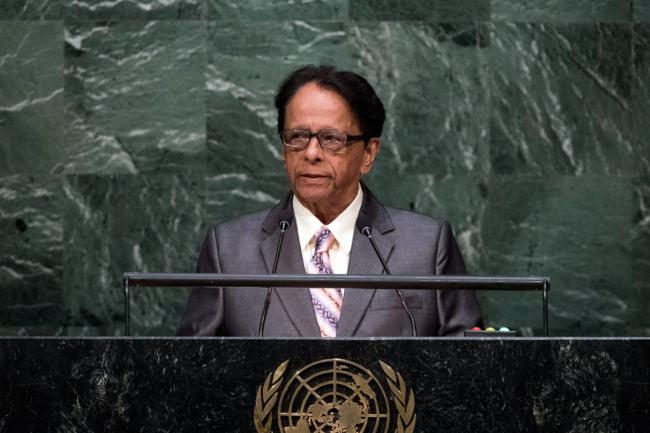
“We are particularly supportive of the recommendation for stronger and deeper partnerships between global and regional organisations to promote international peace and security” Prime Minister Anerood Jugnauth of Mauritius told the Assembly’s 70th annual General Debate , lauding Secretary-General Ban Ki-moon’s initiative to review peace buildings mechanisms.
He cited the collective efforts of the UN, the African Union (AU), the Southern African Development Community (SADC), the Indian Ocean Commission and other regional economic communities in resolving the recent political stalemate in Madagascar.
Similar collaboration has also enabled the AU to deploy robust operations in complex situations in Mali, the Central African Republic and Somalia, he noted.
On climate change, Jugnauth said small island developing States (SIDS) like his own, which lies in the Indian Ocean off the east coast of Africa, are particularly vulnerable to natural hazards, voicing the hope the global conference on the issue in Paris in December will succeed.
“Mauritius believes that the greatest challenge to peace and security in the years to come will be climate change which requires our utmost attention now,” he declared.
He added, “Let there be a carve-out for SIDS, the most vulnerable of all the least developed countries and Africa, to enable them to implement fully the necessary mitigation and adaptation measures. Let financing be available and predictable in addition to the sharing of technology to address a collective threat.”
From the Atlantic side of Africa, Sao Tome and Principe also highlighted the importance of cooperation.
“Located in the Gulf of Guinea, where we have seen a fresh outbreak of acts of maritime piracy, terrorism, drug trafficking, oil heists, and other transnational organized crimes, Sao Tome and Principe understands that the international community must combine its efforts to put a stop to such acts,” Foreign Minister Manuel Salvador dos Ramos told the Assembly.
He cited various existing partnerships, both bilateral and multilateral, and the cooperation among the Economic Community of Central African States (ECCAS), the Economic Community of West African States (ECOWAS) and the Gulf of Guinea Commission (GGC) in promoting significant progress against criminal organizations in the region.
On climate change, his country hopes that agreement, once it is reached, will enhance the international obligation of all signatory parties to make funds available for the continued scientific monitoring of climate issues and the transfer of technology to developing countries.
From Tuvalu in the South Pacific, Foreign Minister Taukelina Finikaso noted that climate is an existential issue for his small island nation, whose highest point is only 15 feet above sea level.
“Sea level rise continues to inundate many of our small island coastlines and inundate our food plantations,” he said.
He added, “That is a security issue, an urgent one and an inter-generational one. It is an existential issue for Tuvalu and other Pacific countries and also bigger populated countries in the flood plains, and wilt displace many people.
he said, “Whilst many of our citizens are opting to migrate on their own terms because of existential issues, migration does not solve global warming and the UN does not sanction climate change migrants as refugees. That is a dilemma for us in Tuvalu.”
He stressed that the Paris conference must reduce greenhouse gas emissions to keep the global average temperature rise to beiow1.5 degrees Celsius, as well as provide credible, timely public finance and clarity from developed countries to the pledges of $100 billion for climate change finances.
Kiribati, a Pacific Island State straddling the Equator, stressed the need for a collective global effort to help those nations most threatened by climate change. “We cannot do it alone,” Natanaera Kirata, Minister of Public Works and Utilities said.
“We call for new and accessible financial resources to assist the most vulnerable to adapt and build resilience to climate change,” he added.
He added, “We must all step up our national and collective efforts to mitigate global greenhouse gas emissions. We must urge major greenhouse gas emitters to do their part.”
He said the new challenges demanded all the resources available to the global community since sustainable development and global challenges such as climate change should not be confined to the sphere of Governments only.
“Let us call on those with the ability to assist and who have a contribution to make, to join in the global dialogue and more importantly, join urgent action to address this major challenge,” he declared.
UN Photo/Cia Pak
Support Our Journalism
We cannot do without you.. your contribution supports unbiased journalism
IBNS is not driven by any ism- not wokeism, not racism, not skewed secularism, not hyper right-wing or left liberal ideals, nor by any hardline religious beliefs or hyper nationalism. We want to serve you good old objective news, as they are. We do not judge or preach. We let people decide for themselves. We only try to present factual and well-sourced news.
Support objective journalism for a small contribution.