 Artificial Intelligence
At UK’s AI Summit, Antonio Guterres says risks outweigh rewards without global oversight
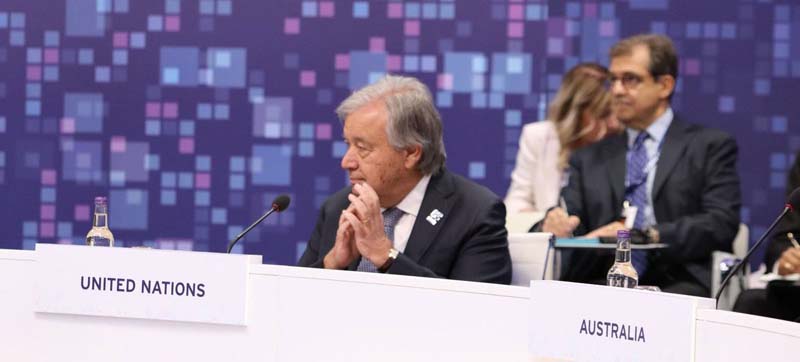
The UN Secretary-General on Thursday (November 2, 2023) stressed that global oversight of emerging artificial intelligence (AI) technology should be based on the UN Charter’s core principles and ensure full respect for human rights.
Addressing the Summit on Artificial Intelligence Safety convened by the United Kingdom, at the famous Bletchley Park estate – where Allied code breakers made a huge contribution to the war effort cracking Nazi codes – the UN chief emphasized the need for “sustained and structured conversation” around its risks, challenges and opportunities.
“The United Nations – an inclusive, equitable and universal platform for coordination on AI governance – is now fully engaged in that conversation,” he said.
Three key areas
The Secretary-General outlined three key areas for immediate action.
First, he called for addressing existing threats related to the release of powerful AI models which currently lack sufficient guardrails and oversight.
Second, Guterres expressed concerns about the long-term negative consequences of AI, including its impact on jobs; the erosion of cultural diversity erosion due to biased algorithms and the stoking of geopolitical tensions arising from the concentration of AI corporations in just a handful of countries.
The third concern was that in the absence of immediate action, AI will exacerbate inequalities that are already growing wider.
“This is not a risk; it’s a reality,” he warned.
Ethical principles
To address these concerns, Guterres mentioned the development of over 100 different sets of often overlapping ethical principles for AI.
While there is broad agreement on principles such as reliability, transparency, accountability and the ability to shut down AI applications, global oversight is needed to prevent incoherence and gaps, he urged.
The UN chief highlighted the launch of his new Advisory Body on AI, which consists of experts from government, business, the tech community, civil society, and academia.
“It is truly universal, with representation from all parts of the world, in order to foster the networked, inclusive, evidence-based solutions that are needed,” he said.
Partnerships for future
The Advisory Body will work in tandem with other global initiatives set up through the EU and the G7, for example, and will provide preliminary recommendations by the end of the year on building scientific consensus and making AI work for all of humanity.
These recommendations will feed in to the Global Digital Compact, proposed for adoption at the UN’s Summit of the Future next September.
“In other words — its work will embed AI governance into intergovernmental processes, and an established global Summit,” Guterres said.
Support Our Journalism
We cannot do without you.. your contribution supports unbiased journalism
IBNS is not driven by any ism- not wokeism, not racism, not skewed secularism, not hyper right-wing or left liberal ideals, nor by any hardline religious beliefs or hyper nationalism. We want to serve you good old objective news, as they are. We do not judge or preach. We let people decide for themselves. We only try to present factual and well-sourced news.
Support objective journalism for a small contribution.