October 19, 2026 04:04 am (IST)

Follow us:


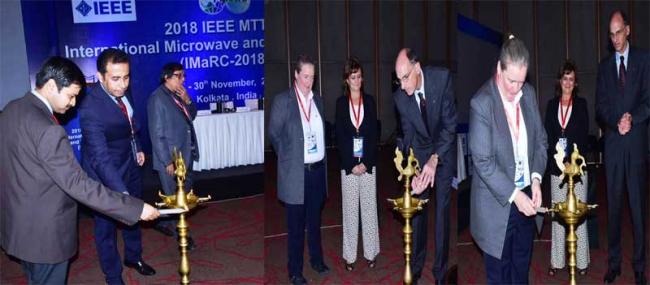
IEEE Microwave Theory and Techniques Society hold their annual International Microwave and RF Conference
Kolkata, Nov 28 (IBNS): The annual International Microwave and RF Conference (ImaaRC) was recently held in Kolkata under the aegis of IEEE Microwave Theory and Techniques Society (MTT-S).
The annual conference aims to provide a platform for the international community of micro wave engineers to present their latest technological achievements in microwave and RF components, circuits, systems and modelling methods and exchange ideas with fellow participants, according to the organisers.
The genesis of the IMaRC series of conferences can be traced back to the India Initiative adopted by the IEEE Microwave Theory and Techniques Society (MTT-S) in 2005, under the guidance of the President of the Society in 2005, Late Professor K. C. Gupta.
This led to several MTT-S delegations visiting India in 2006, 2008, and 2009, including discussions with MTT-S membership in India, and participation in local conferences.
These visits resulted in the establishment of numerous new MTT-S chapters in IEEE India Section, a surge in the membership of the MTT-S in India, and the creation of a Sister-Society relationship with a technical society in India having similar field of interest (FOI), said the organisers.
With that backdrop, one of the projects undertaken was to establish an annual conference in India within the FOI of the MTT-S.
The IMaRC series of annual conferences is the result of that effort.
Principal goals of the conference included providing researchers in India the opportunity to present their results at a conference of the stature of a state-of-the-art international conference in the microwave field; creating a forum for the presentation of selective, high quality research work in India; and helping develop the skills of local researchers at preparing their results for dissemination through international conferences and journals.
IMaRC facilitates the retrieval of presented research reports both through the IEEE Xplore data base, and by publishing an extended version of best of the submitted papers in a Special Issue of the IEEE Trans. Microwave Theory & Techniques, according to the organizers.
The conference was accompanied with an exhibition reflecting developments in instrumentation, software, and turn-key systems to the attention of the attendees.
There were also a number of concurrent activities to encourage the participation and training of students, and humanitarian applications of the RF and microwave technologies, and several IEEE MTT-S volunteer meetings.
In their joint statement, the co-chairs reminded the participants the glorious role Kolkata played in the history of communication engineering, especially in the field of microwaves, that world’s first microwave and millimeter engineer, Sir J.C. Bose, performed his pioneering experiments here.
A frequency as high as 60 GHz was chosen by him to demonstrate the optical properties of electromagnetic waves in late nineteenth century and thereby he established beyond any doubt the electromagnetic nature of light, they said.
The conference was led by George Panchak of NASA Glen Research Centre and Jawad Y Siddique, University of Calcutta, supported by delegates from ISRO, IIT Kharapur, University of Jadavpur, Istanbul University, IIT Delhi, IIT, BHU, University of Bologna, Italy, IIT Guwahati, and IIT Kanpur.
Support Our Journalism
We cannot do without you.. your contribution supports unbiased journalism
IBNS is not driven by any ism- not wokeism, not racism, not skewed secularism, not hyper right-wing or left liberal ideals, nor by any hardline religious beliefs or hyper nationalism. We want to serve you good old objective news, as they are. We do not judge or preach. We let people decide for themselves. We only try to present factual and well-sourced news.
Support objective journalism for a small contribution.
Latest Headlines
Onion prices set to get relief? Centre sends 440 tonnes to Tripura ahead of festive season
Fri, Oct 16 2026
12 nations turn to Bengal: ICC hosts diplomats in Kolkata to explore trade and investment opportunities
Thu, Oct 15 2026
Hyundai announces $15.5 billion India investment plan through 2032: Here's what's coming
Wed, Oct 14 2026
Modi, Anita Anand discuss trade, defence and energy as India-Canada ties gain momentum
Wed, Oct 14 2026
Government approves Fairfax Financial as strategic buyer for 60.72% stake in IDBI Bank
Wed, Oct 14 2026