


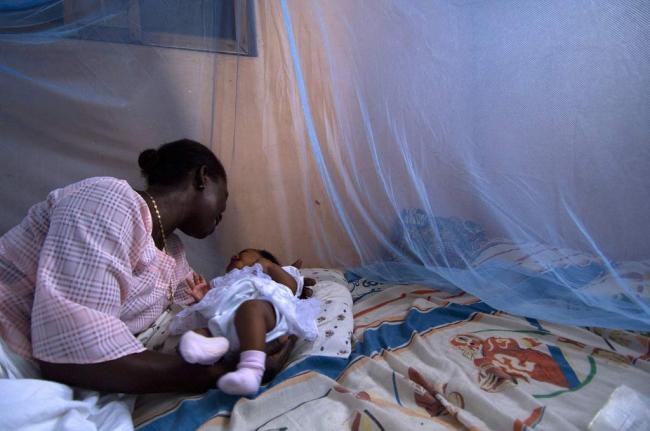
World Malaria Day: UN officials urge investment in fight against the disease
At an event held at UN Headquarters in New York on Monday and bringing together senior Organization officials, diplomatic leaders and development experts, the United Nations-supported Roll Back Malaria Partnership confirmed that 64 out of 97 countries are now on track to meet the malaria-specific Millennium Development Goal (MDG) aimed at reversing malaria incidence by 2015.
“Together, we have already made huge strides in our efforts to combat this preventable and treatable disease,” Sam Kutesa, President of the UN General Assembly, told those gathered.
“Nevertheless, there is still more work to be done to achieve a world free of malaria,” he continued.
He added, “To reach our goals, we must have continued investments and sustained political commitments for malaria control and elimination.”
According to the latest report by the World Health Organization (WHO), malaria mortality rates have decreased by 47 per cent worldwide and 54 per cent in Africa alone since 2000. Since 2001, it is estimated that more than 4 million malaria-related deaths have been averted, approximately 97 per cent of which have been children under five.
The event – which comes ahead of this year’s commemoration of World Malaria Day, marked on 25 April – also spotlighted the $100 billion price tag required to eliminate the mosquito-borne disease by 2030.
To that point, the Roll Back Malaria Partnership noted that despite its high cost, the investment nevertheless carried “a significant return”: a potential 12 million lives saved, nearly 3 billion cases averted globally and a global gain of $270 billion if the disease is eradicated in sub-Saharan Africa alone.
“A new generation now has the chance to grow up and contribute to their societies thanks to the work carried out by the malaria community,” Jan Eliasson, Deputy Secretary-General of the United Nations said in his remarks to the event.
“Fighting malaria is indeed one of the most cost-effective public health investments of our time. We cannot afford to stop investing now.”
Photo: World Bank/Arne Hoel
Support Our Journalism
We cannot do without you.. your contribution supports unbiased journalism
IBNS is not driven by any ism- not wokeism, not racism, not skewed secularism, not hyper right-wing or left liberal ideals, nor by any hardline religious beliefs or hyper nationalism. We want to serve you good old objective news, as they are. We do not judge or preach. We let people decide for themselves. We only try to present factual and well-sourced news.
Support objective journalism for a small contribution.


