


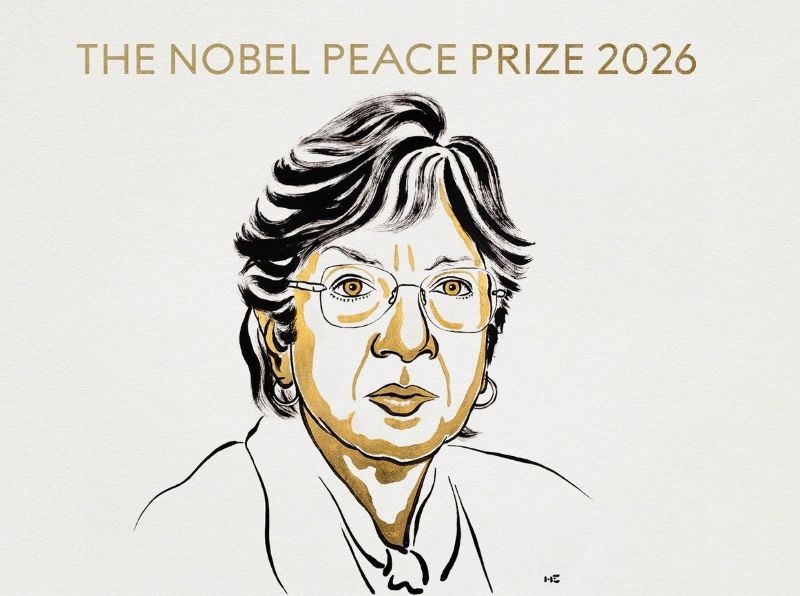
 Nobel Peace Prize
Who is Navi Pillay? Indian-origin South African jurist wins Nobel Peace prize
Navanethem “Navi” Pillay, the Indian-origin South African jurist, has won the Nobel Peace Prize for her efforts to promote peace and uphold international law, the awarding committee said on Friday.
“Navi Pillay’s commitment to universal legal principles and her firm moral compass are constants in a long career,” the committee said.
Born into a family of Indian Tamil origin in Durban, South Africa, during the apartheid era, Pillay became a lawyer and a legal pioneer, challenging systemic discrimination, segregation and exclusion.
A common thread runs through her career, from her early work defending Nelson Mandela and others who fought against apartheid to her role as a judge in some of the most significant international legal cases of our time.
This year’s laureate has significantly expanded the scope and impact of international law.
Pillay has served as a judge on South Africa’s High Court, the International Criminal Tribunal for Rwanda and the International Criminal Court. She has also served as the United Nations High Commissioner for Human Rights and, until recently, chaired the UN Independent International Commission of Inquiry on the Occupied Palestinian Territory.
Pillay is currently serving as a judge at the International Court of Justice in the case in which Myanmar stands accused of genocide. Through her involvement in landmark international legal proceedings, she has demonstrated how legal mechanisms can help prevent war and violence.
She has also played a significant role in strengthening international legal institutions. Her independence, expertise and steadfast commitment to justice have made her one of the most respected international jurists of our time.
The Nobel Peace Prize was the fifth Nobel award announced this week, following the announcements of the prizes in literature, chemistry, physics and medicine.
Belief in international solidarity
In a 2025 interview with UN News, Pillay reflected on her lifetime of fighting for human rights, justice and equality.
“I didn't think apartheid would end in my lifetime,” she recalled. “So, what happened? We had the collective support of people all over the world, even children. If we can achieve that, we can have a better human rights protection system.”
As UN human rights chief, she continued to champion the participation of civil society and victims’ voices in shaping global human rights standards.
“When the UN started, it was just a club for the States,” she told UN News. “Everything we have today for human rights protection didn’t happen just because the States woke up one day. It comes from the pressure of civil society. That’s why I value these institutions.”
Gaza factor
Pillay headed the UN Independent International Commission of Inquiry (COI), which concluded last year that genocide was taking place in Gaza.
Israel has strongly rejected the commission’s findings, while critics have questioned its impartiality.
Israel’s Foreign Ministry accused the commission of promoting a malicious narrative aimed at demonising the country, alleging that it had relied on selectively presented evidence and made claims that its own material could not substantiate. The ministry also called for the commission to be abolished, i24 News reported.
Pillay’s work has also included documenting crimes committed during the Hamas-led attacks on Israel on October 7, 2023.
Her position has centred on international law, the protection of civilians and Palestinian self-determination.
The award comes against the backdrop of the commission’s findings on Gaza, bringing renewed attention to Pillay’s outspoken position on Israel and the broader debate over accountability, the impartiality of international investigations and Palestinian rights.
However, the commission’s conclusion remains an investigative finding and does not constitute a final judgment by a court of law.
Support Our Journalism
We cannot do without you.. your contribution supports unbiased journalism
IBNS is not driven by any ism- not wokeism, not racism, not skewed secularism, not hyper right-wing or left liberal ideals, nor by any hardline religious beliefs or hyper nationalism. We want to serve you good old objective news, as they are. We do not judge or preach. We let people decide for themselves. We only try to present factual and well-sourced news.
Support objective journalism for a small contribution.


