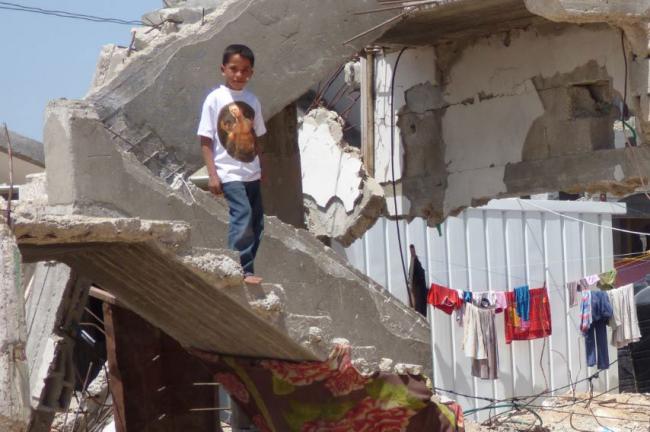
UN survey finds displaced Palestinian families in Gaza Strip live in desperate conditions
In a press release, the UN Office for the Coordination of Humanitarian Affairs (OCHA) said it conducted an “unprecedented profiling exercise” of Palestinian families internally displaced in the Gaza Strip.
“After hearing from over 16,000 displaced families in the Gaza Strip, it is clear that most continue to live in desperate conditions,” said Robert Piper, the UN Coordinator for Humanitarian Aid and Development Activities for the occupied Palestinian territory. “International support to end this situation is urgently needed,” he said.
According to the survey, more than 80 per cent of families borrowed money to get by in the past year, more than 85 per cent purchased most of their food on credit, and more than 40 per cent have decreased their consumption of food.
In addition, some 62.5 per cent of internally displaced households reported that they are renting living space, including from extended family members, and nearly 50 per cent fear being evicted from their accommodations.
The situation of women and girls is of particular concern, OCHA said. Many families report living in shelter conditions that are lacking in safety, dignity and privacy, including living in tents, makeshift shelters, destroyed houses, or the open air.
“Funding is needed more than ever. We face a funding gap to reconstruct some 6,600 houses, or about 37 per cent of the overall caseload. Without this support, thousands of Palestinians will see no end to their displacement,” said Piper.
“But this support must go hand in hand with significant changes at the policy level, including a lifting of the blockade and progress towards Palestinian reconciliation. Without such action, coping capacities of exhausted and vulnerable households risk being depleted altogether,” he concluded.
Photo: OCHA
Support Our Journalism
We cannot do without you.. your contribution supports unbiased journalism
IBNS is not driven by any ism- not wokeism, not racism, not skewed secularism, not hyper right-wing or left liberal ideals, nor by any hardline religious beliefs or hyper nationalism. We want to serve you good old objective news, as they are. We do not judge or preach. We let people decide for themselves. We only try to present factual and well-sourced news.
Support objective journalism for a small contribution.