


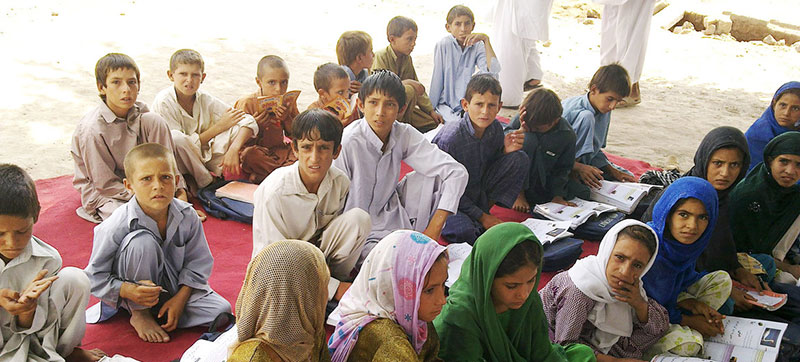
 Child Crisis
UN-backed initiative reached 4.6 million children in ‘crisis within a crisis’
New York: In 2020, the COVID-19 pandemic devastated education systems throughout the world, making the year even more difficult for youngsters already embroiled in emergencies and protracted crises, according to a new UN-backed report launched on Tuesday, coinciding with World Teachers Day.
UN-supported Education Cannot Wait (ECW) – the first global fund dedicated to education in emergencies and protracted crises – described the pandemic as a “risk-multiplier”, which has not only created new challenges but also amplified existing risks for the most vulnerable groups, particularly girls, children and adolescents with disabilities.
“For the millions of marginalized youth already caught up in crises, COVID-19 further impacted their lives as a ‘crisis within a crisis’”, Gordon Brown, UN Special Envoy for Global Education and the Chair of ECW High-Level Steering Group, said at the report launch.
‘Uniquely challenging year’
Learning losses also threaten future generations as well as decades of progress.
The UN education agency, UNESCO, estimated that globally, 1.5 billion students, from pre-primary to upper-secondary level, had experience some sort of learning interruption as a result of school closures in early 2020.
“2020 will be remembered as a uniquely challenging year”, said the Special Envoy.
According to the ECW report, this will aggravate the pre-pandemic rate of learning poverty, affecting 53 per cent of children in low and middle-income countries who by 10 years of age could not read or understand a simple text.
Combatting irreversible loss
To stem irreversible loss, ECW said it had stepped in to ensure every child has access to a safe, inclusive learning environment by adapting their response to supporting quality education for students caught in armed conflicts, forced displacement, climate change-induced disasters and protracted crises.
Shortly after the World Health Organization (WHO) declared the global pandemic in March 2020, ECW initiated a substantive package of grants targeting all countries with ongoing investments. $23 million was allocated from the First Emergency Funding (FER) reserve within 21 days, and a further $22.4 million was sent in July 2020.
The funds were distributed across 85 grants in 32 countries and emergency contexts, to minimize the impact on education in crisis-affected areas and ensure children and adolescents were able to continue learning.
“ECW’s COVID-19 emergency grants reached over 29 million children and adolescents – including 51 per cent girls – in 32 crisis-affected countries and contexts”, said Mr. Brown.
2020 in numbers
4.6 million: total children and youth reached with ECW support
1.7 billion: total resources mobilized
$45.4 million: approved for 32 countries to respond to the pandemic
310,600: teachers trained, 55 per cent of whom were women
“The Fund also increased the number of adolescents it reached with secondary education by 50 per cent and more than doubled the number of children it reached with pre-primary education”, he added.
Classroom hurdles
According to ECW, one in four of the world’s school-aged children live in countries affected by crisis.
And yet, only between two to four per cent of humanitarian aid goes towards education.
This means 75 million children need educational support.
“Today, a lot must be done to overcome the hurdles keeping children out of school”, said the Special Envoy, calling on public and private donors to “step up their funding” so that “we become the first generation in history in which each single child goes to school”.
Brown concluded by stating the goal “to ensure that instead of some children developing some of their potential, in some of the world’s countries, all children can develop all their potential in every country.”
Support Our Journalism
We cannot do without you.. your contribution supports unbiased journalism
IBNS is not driven by any ism- not wokeism, not racism, not skewed secularism, not hyper right-wing or left liberal ideals, nor by any hardline religious beliefs or hyper nationalism. We want to serve you good old objective news, as they are. We do not judge or preach. We let people decide for themselves. We only try to present factual and well-sourced news.
Support objective journalism for a small contribution.


