


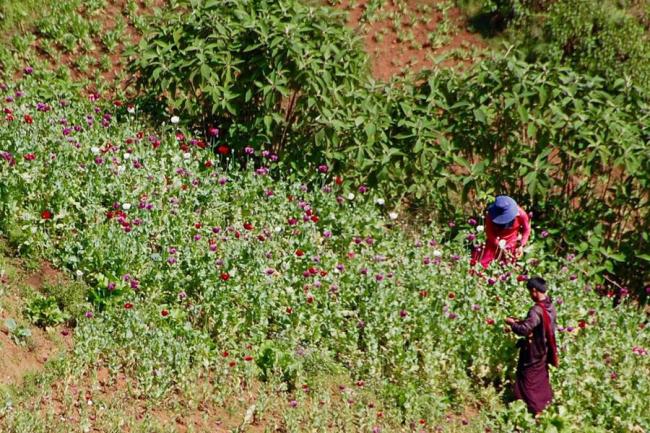
Opium production in Myanmar and Laos are stable at high levels, new UN report shows
“The production of opium and two-way trade of chemicals going in and heroin coming out of the Golden Triangle remains a clear challenge to the rule of law and stability of producing areas,” said Jeremy Douglas, UNODC Regional Representative for Southeast Asia and the Pacific of the region straddling Myanmar, Laos and Thailand.
The 2015 Southeast Asian Opium Survey shows that Myanmar remains that region’s top opium producer – and the world's second largest after Afghanistan.
Together, Myanmar and Laos produced between 731 and 823 metric tonnes of opium, most of which was refined into the equivalent of roughly 73.1 to 82.3 metric tonnes of street grade heroin for regional and international drug markets, according to the report.
“The region’s demand for heroin remains at unacceptably high levels and transnational organized crime groups are making huge profits,” Douglas said. “And while the stabilization of poppy cultivation in the past year is encouraging, the Government-elect of Myanmar and the Government of Lao PDR have no choice but to face the underlying issues that allow opium cultivation and related trafficking to continue.”
The report noted that Shan state in the north of Myanmar, which hosts a number of conflict areas and ceasefire groups, remains the centre of the country’s opium and heroin trade, accounting for 91 per cent of opium poppy cultivation in the Golden Triangle.
Surveys of farmers in poppy-growing villages have found that money generated from poppy cultivation is essential for villagers threatened with food insecurity and poverty.
Douglas warned that the opium and heroin business threatens well-intentioned regional development plans.
“The organized crime networks that benefit from Southeast Asia’s illicit drug trade are very well positioned to grow their business alongside these rapid changes,” he said. “Both Myanmar and Lao PDR need support to turn the situation around.”
Photo: UNODC
Support Our Journalism
We cannot do without you.. your contribution supports unbiased journalism
IBNS is not driven by any ism- not wokeism, not racism, not skewed secularism, not hyper right-wing or left liberal ideals, nor by any hardline religious beliefs or hyper nationalism. We want to serve you good old objective news, as they are. We do not judge or preach. We let people decide for themselves. We only try to present factual and well-sourced news.
Support objective journalism for a small contribution.


