


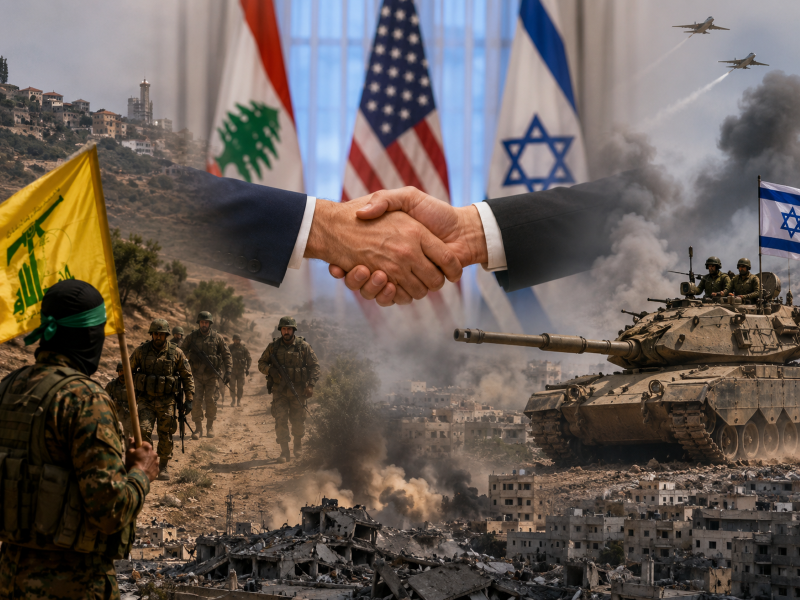
Israel, Lebanon agree to new ceasefire framework, but Hezbollah's rejection clouds deal
Israel and Lebanon have agreed to implement a new ceasefire framework aimed at halting months of cross-border fighting, but uncertainty remains after Hezbollah reportedly rejected the proposal and Israel signalled it would continue military operations despite the announcement.
The agreement emerged from US-mediated talks in Washington and includes provisions for a complete cessation of fire and the establishment of security zones in southern Lebanon, Al Jazeera reported.
Ceasefire calls for end to hostilities
According to a joint statement issued after the talks, the ceasefire is contingent on a "complete cessation" of fire by Hezbollah and the withdrawal of the group's operatives from southern Lebanon.
The two sides also agreed to establish pilot zones where the Lebanese Armed Forces would assume exclusive control, excluding all non-state actors.
The agreement effectively seeks to reinforce and expand an earlier ceasefire arrangement reached in May rather than create an entirely new truce.
Hezbollah signals opposition to deal
The future of the agreement remains uncertain after a Hezbollah official told AFP that the group had informed Lebanese authorities it rejected the ceasefire framework.
The official said Hezbollah chief Naim Qassem had conveyed the movement's position through Parliament Speaker Nabih Berri, a key Hezbollah ally who is acting as an intermediary.
Lebanese President Joseph Aoun had earlier said he was awaiting Hezbollah's formal response.
Fighting continues despite announcement
Hostilities continued even as the ceasefire was announced.
Hezbollah claimed responsibility for attacks targeting Israeli soldiers, while Israeli strikes reportedly killed at least 10 people in southern Lebanon on Wednesday.
Hours after the agreement was unveiled, air raid sirens sounded in northern Israel after a suspicious aerial target was detected. No casualties were reported.
On Thursday, Lebanese media reported additional Israeli strikes in the Bekaa Valley and southern Lebanon, including attacks on Sohmor, Tell al-Aqareb, Haddatha, Tibnin, Haris, Kfar and Harin.
Israel says military operations will continue
Israeli Defence Minister Israel Katz said the military would continue operating in Lebanon and would not immediately withdraw from occupied positions.
He also indicated that displaced Lebanese residents would not yet be allowed to return to their homes in the south.
According to Katz, Israel would retain the freedom to strike targets in Lebanon, including Beirut, in response to attacks against Israeli territory.
The remarks underscored the challenges facing efforts to transform the ceasefire into a lasting peace arrangement.
Lebanon begins security deployment
Lebanese Prime Minister Nawaf Salam said the Lebanese Army would begin deploying to the agreed pilot zones as part of the first phase of implementation.
President Aoun described the latest negotiations as difficult but characterised the agreement as a "last opportunity" to secure a comprehensive ceasefire, said reports.
He warned that all parties would bear responsibility if the framework failed.
Iran insists regional conflicts are linked
The ceasefire discussions unfolded against the backdrop of wider regional tensions involving Iran.
While US President Donald Trump has sought to separate negotiations over Lebanon from talks concerning the conflict with Iran, Tehran has rejected that approach.
Iranian Foreign Minister Abbas Araghchi warned that any major attack on Beirut could trigger a renewed escalation, while Esmail Qaani called for Israel's withdrawal from positions occupied during the current conflict.
With Hezbollah yet to formally endorse the agreement and both sides continuing military operations, the durability of the ceasefire remains uncertain despite the diplomatic breakthrough.
Support Our Journalism
We cannot do without you.. your contribution supports unbiased journalism
IBNS is not driven by any ism- not wokeism, not racism, not skewed secularism, not hyper right-wing or left liberal ideals, nor by any hardline religious beliefs or hyper nationalism. We want to serve you good old objective news, as they are. We do not judge or preach. We let people decide for themselves. We only try to present factual and well-sourced news.
Support objective journalism for a small contribution.


