


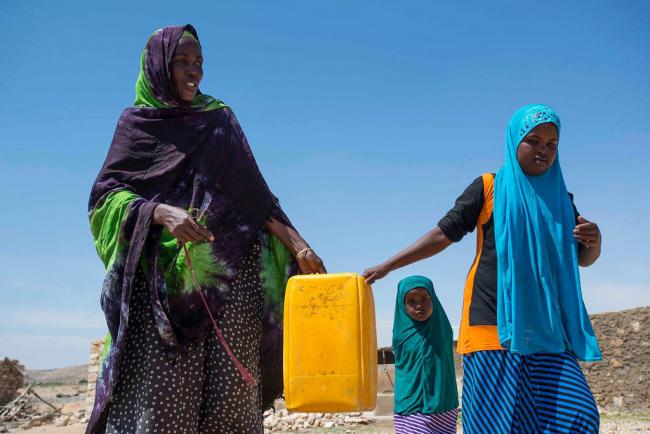
Drought threatens 1.5 million Somalis; UN health agency scales up response
“Somalia is now at a critical point as a result of this drought and environmental hazards and lack of basic services,” said UN World Health Organization's (WHO) Regional Director for the Eastern Mediterranean, Dr. Mahmoud Fikri.
The UN agency said that it is providing “all possible support” to address the ongoing challenges. That includes sending in rapid response teams to areas of greatest threat. That includes sending medicines and medical supplies to health facilities in drought-affected areas.
Some 1.5 million people are believed to be affected by the severe drought and worsening food crisis. More than 400,000 of those people are malnourished children.
In addition, the drought conditions are causing epidemic-prone diseases to spread. These include cholera and measles. According to WHO, since early January, more than 6,000 cases of cholera have been reported, as well as more than 2,500 cases of suspected measles.
The UN has launched an appeal for $825 million for the first half of 2017 for the pre-famine response. Of this, the health sector requires $85 million, including $10 million for the WHO.
Photo: UNICEF Somalia/Sebastian Rich
Source: www.justearthnews.com
Support Our Journalism
We cannot do without you.. your contribution supports unbiased journalism
IBNS is not driven by any ism- not wokeism, not racism, not skewed secularism, not hyper right-wing or left liberal ideals, nor by any hardline religious beliefs or hyper nationalism. We want to serve you good old objective news, as they are. We do not judge or preach. We let people decide for themselves. We only try to present factual and well-sourced news.
Support objective journalism for a small contribution.


