


 Child Rights
DR Congo: Grave consequences for children witnessing ‘appalling violence’, UNICEF reports
New York: The UN Children’s Fund, UNICEF, appealed on Thursday for urgent resources to support thousands of people who have fled armed violence in two small towns in the eastern part of the Democratic Republic of the Congo (DRC) over the past two months.
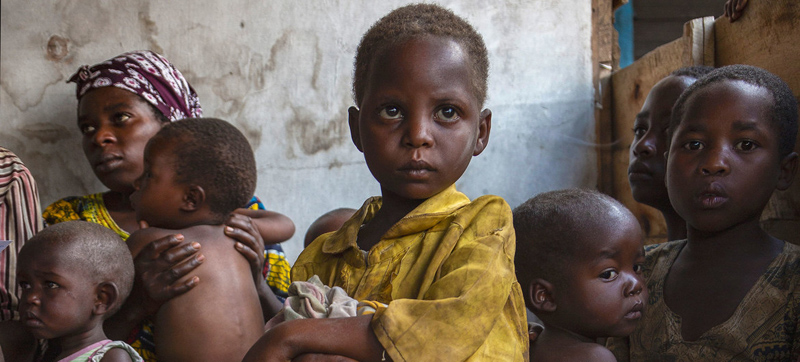
The simultaneous attacks on Boga and Tchabi, located in Ituri Province, have been devastating for children, the agency said, as many have witnessed brutal acts committed by assailants wielding machetes and heavy weapons.
A 12-year-old orphan called Grace is among them.
A child’s plea
Grace arrived unaccompanied at a camp in the provincial capital, Bunia, in early June after she was separated from her grandmother during the attack on her hometown, Boga.
“I was watching television in our house in the middle of the night when the gunmen attacked at four in the morning,” she recalled. “They were firing bullets everywhere and everyone took different paths to flee. As I fled, I saw a mother whose head had been cut off.”
Grace managed to find a vehicle that was taking displaced people from Boga to Bunia, a journey of more than 100 km. UNICEF and partners are trying to reunite her with her grandmother.
Meanwhile, Grace is being cared for by a foster mother in a crowded shelter in one of two main camps in Bunia housing more than 20,000 displaced people.
“I ask the world not to ignore the appalling violence that is going on here,” she said. “We must do all we can to get rid of people who kill innocent civilians.”
Entire families killed
Similar attacks like the ones on Boga and Tchabi have uprooted whole communities, UNICEF said, with reports of entire families, including children, hacked to death. Health centres and schools have been ransacked, and whole villages set on fire.
Around 90 per cent of the population fled the Boga area in the wake of the twin assaults, with people seeking sanctuary north, south and east of the town.
“It is estimated that about 30,000 people have fled their homes in the recent displacements, including more than 9,500 in Bunia,” said Dr. Ibrahim Cisse, UNICEF Bunia Chief Field Officer.
Most of the displaced stay with friends and relatives in the host community, not in camps, and needs are great, particularly for food, essential household items and other non-food items.
Support for displaced people
UNICEF is working with humanitarian partners to distribute thousands of household essentials, and sanitary and hygiene kits, in addition to providing tarpaulins to more than 4,000 households.
Dr Cisse said it was unlikely that people will be able to return to their homes despite military operations to eliminate armed groups in the Boga area.
UNICEF has urgently appealed for resources to support the displaced, mostly children and women, who have suffered serious rights violations, including rape.
Top priorities include working to reunite children separated from their families, or recruited into armed groups, as well as providing access to healthcare, nutrition, drinking water, education and other basic necessities.
In a report published earlier this year, UNICEF called for an end to the conflict in the eastern DRC, which has generated one of the worst humanitarian crises in the world.
Some 1.6 million people were driven from their homes in the first six months of 2020 alone.
Overall, 5.2 million Congolese are displaced, which is more than in any country, except Syria.
Support Our Journalism
We cannot do without you.. your contribution supports unbiased journalism
IBNS is not driven by any ism- not wokeism, not racism, not skewed secularism, not hyper right-wing or left liberal ideals, nor by any hardline religious beliefs or hyper nationalism. We want to serve you good old objective news, as they are. We do not judge or preach. We let people decide for themselves. We only try to present factual and well-sourced news.
Support objective journalism for a small contribution.


