


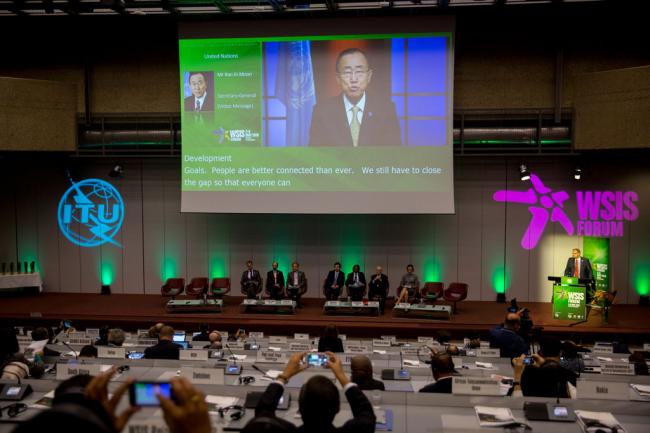
At high-level forum, UN spotlights power of information technology in advancing development
“Information and communication technologies are the drivers of the global economy and have revolutionized how we communicate, interact socially and do business,” Ban stressed in a video message to the opening of the annual UN World Summit on the Information Society (WSIS) Forum in Geneva, which is hosted by the UN International Telecommunications Union (ITU).
“ICTs also provide innovative solutions to combat climate change, improve health care and education, and empower women and the vulnerable,” the Secretary-General said.
Ban highlighted that the ICTs will be critical to advancing the 2030 Agenda for Sustainable Development, implementing the Paris Agreement on climate change, and achieving the Sustainable Development Goals (SDGs).
“People are better connected than ever, but we still have to close the gap so that everyone can benefit from ICTs. We have to ensure that everyone has freedom of access to information,” the UN chief said.
He urged participants to continue working to ensure universal access to a more open information society.
“Let us empower people everywhere with these transformative technologies so that they can help build a better future for all,” Ban said.
Along those lines, ITU Secretary-general Houlin Zhao noted in a separate video message that putting ICTs at the heart of global development will be critical to meeting the SDGs.
“The WSIS process is all about helping to bridge the digital divide so that people everywhere can reap the tremendous benefits of connectivity,” Zhao said.
“Let us strive to empower individuals with transformative technologies that can change their lives, the lives of their families and their communities, so that we can all share in a more prosperous and more equitable future,” he added.
The forum – whose over-arching theme is ‘WSIS Action Lines: Supporting the implementation of the SDGs’ – is co-organized by the UN Educational, Scientific and Cultural Organization (UNESCO), the UN Conference on Trade and Development (UNCTAD) and the UN Development Programme (UNDP), in collaboration with the UN and sister agencies.
This year’s event is being chaired by Daniel A. Sepulveda, Deputy Assistant Secretary of State and Coordinator for International Communications and Information Policy in the United States State Department’s Bureau of Economic and Business Affairs.
The forum, which will conclude on Friday, 6 May, is expected to include 1,800 participants, including more than 85 government ministers and 250 high-level representatives. Sessions will focus on, among other things, cybersecurity, promoting peaceful and inclusive knowledge societies, and implementing best practices and addressing challenges.
Photo: ITU/I. Wood
Support Our Journalism
We cannot do without you.. your contribution supports unbiased journalism
IBNS is not driven by any ism- not wokeism, not racism, not skewed secularism, not hyper right-wing or left liberal ideals, nor by any hardline religious beliefs or hyper nationalism. We want to serve you good old objective news, as they are. We do not judge or preach. We let people decide for themselves. We only try to present factual and well-sourced news.
Support objective journalism for a small contribution.


