


'An entire generation could be crippled by hunger' in Yemen – UN food relief agency
“Hunger is increasing every day and people have exhausted all their survival strategies. Millions of people cannot survive without external assistance,” said Muhannad Hadi, the World Food Programme (WFP) Regional Director for the Middle East, North Africa, Central Asia and East Europe in a news release.
He said the conflict in Yemen was taking a devastating toll, particularly on the most vulnerable, especially women and children.
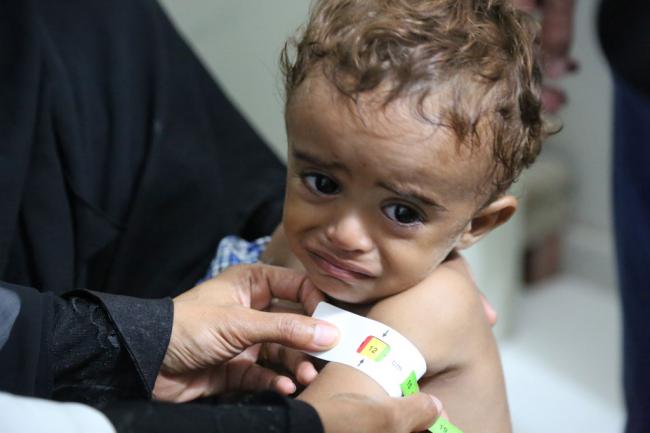
WFP aims to treat and help prevent malnutrition among some 700,000 children under five, pregnant women and nursing mothers. This includes nutritional treatment for children under five and preventative interventions for children under two. This work to counter Moderate Acute Malnutrition (MAM), also known as wasting, is done through local partners in 2,200 health centre in 14 governorates across Yemen.
“An entire generation could be crippled by hunger,” said WFP Country Director Torben Due. “We need to provide a full ration to every family in need, but sadly we have had to reduce the size of the food basket and split assistance between impoverished families to meet growing needs,” he added.
Integrated Food Security Phase Classification findings from June 2016 show that 14.1 million people in Yemen are food insecure, including 7 million who are severely food insecure. In some governorates, 70 per cent of the population struggle to feed themselves.
A senior WFP team recently visited impoverished neighbourhoods and spoke to families and local authorities in Hajjah governorate in northeast Yemen and the Red Sea governorate of Hodeidah. They described a very dramatic situation as people struggle daily to secure their food needs.
The team visited hospitals, nutrition and health centres and saw many cases of malnourished children arriving from remote areas.
“I borrowed money from my neighbours and family to be able to bring my son from Tuhayta district to the hospital here in Hodeidah to get treatment for malnutrition,” said Ihsan, a 26-year-old mother. “I am breastfeeding him but he is slipping away from us and losing more weight every day. I hardly have food to feed my children, let alone to eat well.”
Even before the latest conflict, Yemen had one of the highest rates of malnutrition in the world. In some areas like Hodeidah governorate, Global Acute Malnutrition rates among children under five as high as 31 per cent have been recorded– more than double the emergency threshold of 15 per cent. Almost half of the children countrywide are irreversibly stunted.
The economic impact of the conflict is a catastrophe for Yemen, the poorest country in the Middle East. Millions of public sector employees no longer receive their salaries and struggle to make ends meet. Even before the conflict escalated and imports declined dramatically, Yemen imported some 90 per cent of its food needs.
“We are only surviving on bread as I have nothing else to feed my children and we are lucky if we have enough bread for everyone,” said Fatema, a 45-year-old woman living on the outskirts of Sana'a. “Food prices have gone up and my husband is no longer receiving his salary.”
Insecurity makes access to some of Yemen's malnutrition hotspots a challenge. During the 72-hour humanitarian pause last week, WFP reached three districts in Taiz governorate, providing food assistance to 155,000 people.
Food distribution in some of areas is ongoing and WFP will also cover another 189,000 people in three other locations that were hard to reach in the last few weeks. WFP needs sustained access to the most impoverished governorates, particularly Ma'rib, Al-Jawf and Taiz.
WFP requires over $257 million to provide vital food assistance until March 2017. It takes four months from the time WFP receives funds until food can be shipped to the country and is in the hands of the families who need it.
Photo: WFP/Abeer Etefa
Source: www.justearthnews.com
Support Our Journalism
We cannot do without you.. your contribution supports unbiased journalism
IBNS is not driven by any ism- not wokeism, not racism, not skewed secularism, not hyper right-wing or left liberal ideals, nor by any hardline religious beliefs or hyper nationalism. We want to serve you good old objective news, as they are. We do not judge or preach. We let people decide for themselves. We only try to present factual and well-sourced news.
Support objective journalism for a small contribution.


