Achieving 2030 Agenda will require overcoming rising ‘feeling of chaos,’ Belarus tells UN Assembly
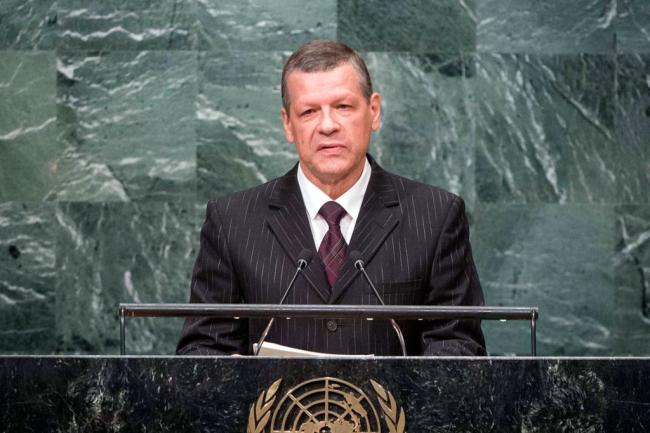
“In other words, we are living in a time of contradictory realities,” Valentin Rybakov said, arguing that on Monday’s turbulence has become a “serious competitor” with positive globalization processes due to several factors, including because the so-called winners of the Cold War did not want to integrate the “losers” into the system, instead attempting to impose their will upon them, with “terrible consequences.” And as a result, the world is in political transition without knowing where it is moving towards.
In economic terms, healthy competition between the market and the State was important, but in recent decades that balance has been disturbed as the market gained the upper hand, and the State has been relegated to ‘second place,’ he said. As a result, a minority of people accumulated more wealth while others suffered; environmental challenges have been exacerbated because the market was concerned only with profit.
Moving on to the less obvious but equally troubling impacts of the social sphere, Rybakov said there is a growing social and cultural gap, marked by the emergence of a counter-culture in the West, he said, questioning why such changes should affect the rest of the world, including those not subject to the same historical reasons for the shift.
Understanding the reasons for the unstable and contradictory world order was a start, but in order to change it, a clear understanding of the desired new world order is needed, he continued. While this is of course, easier said than done [and] ]everyone will have to give up something” the new system should be State-driven because anarchy reigned where the State was weak. It should be inclusive, so that everyone would have a real voice within it, “not just for the sake of appearances.”
The new system could not be imposed, but cultivated, so that it would be viewed as fair by politicians and ordinary people alike. Also, regional blocs increasingly played an independent role that until recently had been the prerogative of States. Cooperation must therefore be established between regions as between States, he said, noting that Belarus is an active participant in a range of regional processes.
Calling for dialogue rather than imposing views on one another, he said by example that Belarus is committed to the values of traditional families, while other countries recognize a variety of forms, Rybakov continued. “We don’t need to demonstrate the [correctness] of our approaches,” he said, explaining that such different approaches could and should lead to a positive result. Belarus saw an opportunity in the UN Commission on Narcotic Drugs – due to meet in March 2017 – in terms of the draft resolution on the role of the family in preventing the illicit drug trade, he said. “Let’s think together about how the family may help in this area, despite the fact that we understand this concept differently,” he said.
UN Photo/Amanda Voisard
Source: www.justearthnews.com
Support Our Journalism
We cannot do without you.. your contribution supports unbiased journalism
IBNS is not driven by any ism- not wokeism, not racism, not skewed secularism, not hyper right-wing or left liberal ideals, nor by any hardline religious beliefs or hyper nationalism. We want to serve you good old objective news, as they are. We do not judge or preach. We let people decide for themselves. We only try to present factual and well-sourced news.
Support objective journalism for a small contribution.