When Calendars Become Quiet Chronicles of Their Time
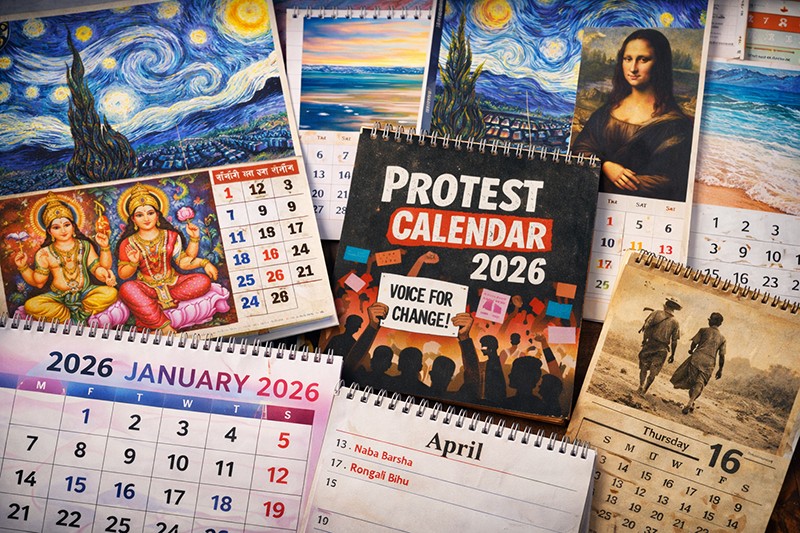
It is that time of the year, like new resolutions—never mind they fizzle out by mid-year—when the subject of calendars comes up. You wonder: do people still hang calendars on the wall? Is it too kitschy for sophisticated apartments with silk-finish walls that would rather adorn a Ganesh Haloi or a Van Gogh print? But then you walk down a nearby lane and see shops with calendars adorning their walls, displaying deities in various avatars, togged up in garish colours, and realise that they are still cherished, indeed.
Come to think of it, at the start of the traditional New Year in April—be it Naba Barsha in Bengal or Rongali Bihu in Assam, as well as in some other regions across India—calendars stoke renewed interest, with traditional month names and festival days jostling for space alongside the Gregorian calendar dates we now follow in workaday life. The Pope introduced it in 1582, recalibrating the existing Julian calendar which Julius Caesar had incorporated in 45 BC, improving upon the Roman calendar.
Originally based on astronomy and the agricultural cycle, calendars today can also serve as a medium to say something more than just displaying beautiful flowers, destinations, and the like along with dates. A calendar brought out by a group of young people in Kolkata this year contains images highlighting slogans of resistance. Recently, Gen Z showed in Nepal that protest slogans can overturn a government accused of corruption and rampant nepotism. Echoes of protest slogans against the current establishment are reverberating in many lands—be it Iran, Georgia, Peru, etc., to name a few.
According to the Global Protest Tracker of the Carnegie Endowment for International Peace, in the last twelve months anti-government protests broke out in 126 countries across the world, and currently there are 33 active protests.
An annual calendar may have the lifetime of a year, but in chronicling such images or messages, it establishes a longer timeline and may even serve as a chronicle of the times. Just think of the farmers’ protest in Delhi not so long ago, or the long marches of citizens across the city of Kolkata post the R. G. Kar rape case, displaying slogans of protest in many hues.
With time, the focus may shift; the once vociferous voices may slowly lose their verve due to changing circumstances, but if caught in a calendar, they can be preserved as if in a still reel. One day, perhaps, a generation beyond the sobriquet of ‘Z’ will look back and find new meaning, new inspiration, to launch yet another cause célèbre—for a calendar.
Support Our Journalism
We cannot do without you.. your contribution supports unbiased journalism
IBNS is not driven by any ism- not wokeism, not racism, not skewed secularism, not hyper right-wing or left liberal ideals, nor by any hardline religious beliefs or hyper nationalism. We want to serve you good old objective news, as they are. We do not judge or preach. We let people decide for themselves. We only try to present factual and well-sourced news.
Support objective journalism for a small contribution.