

 Delhi
‘Right to protest cannot paralyse Delhi’: Traders' body seeks dedicated demonstration zones outside national capital
New Delhi/IBNS: The Confederation of All India Traders (CAIT) has urged Delhi Lieutenant Governor Taranjit Singh Sandhu to notify designated protest and demonstration sites on the outskirts of the national capital, arguing that repeated political gatherings and demonstrations in busy parts of the city are disrupting trade, livelihoods and everyday activities.
In a letter dated November 2, 2026, CAIT National President B.C. Bhartia said recurring protests, marches and public gatherings across Delhi had repeatedly affected commercial operations and inconvenienced residents.
The traders’ body acknowledged that peaceful protest was an essential democratic right but maintained that it should not come at the expense of other citizens’ ability to work, travel and conduct business.
“The right to protest cannot become a right to paralyse the city, just as the right to conduct business cannot be sacrificed in the exercise of democratic freedoms,” CAIT said.
The organisation described Delhi as both the national capital and a major economic centre, supporting millions of livelihoods and serving as a crucial link in the country’s supply and distribution network.
Traders flag disruption to businesses, livelihoods
According to CAIT, recurring demonstrations have affected a wide range of economic stakeholders, including traders, shopkeepers, street vendors, hawkers, daily wage earners, transport operators, delivery personnel, workers and hospitality establishments.
The letter said road blockages, traffic diversions and restricted access to commercial areas had disrupted business operations and made it difficult for customers to reach markets and shops.
The impact, CAIT added, extended beyond established businesses.
Small traders and marginal economic stakeholders who depend on daily earnings were particularly affected by interruptions to commercial activity.
The traders’ body said the situation had created financial losses and uncertainty for businesses, making it necessary to develop a long-term institutional arrangement rather than relying on temporary administrative measures whenever demonstrations take place.
What CAIT wants the Delhi LG to do
CAIT has asked the Lieutenant Governor to identify and officially notify suitable locations, preferably on the outskirts of Delhi, where individuals, organisations and political parties can hold protests, demonstrations, public meetings and political gatherings.
It wants peaceful demonstrations to remain accessible at these designated locations while ensuring that markets, public transport and commercial establishments can function without avoidable disruption.
The organisation has also proposed a permanent and uniform coordination mechanism to manage demonstrations across the capital.
Under the proposed arrangement, authorities would facilitate the exercise of democratic rights without obstructing the city's routine functioning.
CAIT has called for particular attention to the interests of economically vulnerable groups, including small shopkeepers, daily wage earners and transport workers whose income depends on uninterrupted movement and commercial activity.
It has further urged the Lieutenant Governor to direct the Delhi Police, traffic police, Municipal Corporation of Delhi (MCD) and other relevant agencies to work together on a coordinated framework for managing public demonstrations.
CAIT 'does not seek to restrict protest rights'
The traders’ body clarified that its proposal was not intended to curtail the democratic rights of individuals, organisations or political parties to express their views or organise peaceful demonstrations.
Instead, it argued that public gatherings should be managed in a way that respects the rights of other citizens and prevents economic activity in the national capital from coming to a standstill.
CAIT referred to the constitutional guarantee of peaceful assembly, while noting that the exercise of such rights could be subject to reasonable restrictions in the public interest.
The organisation has asked Sandhu to examine its proposal on priority and initiate the process of notifying suitable protest locations outside the city's main commercial areas.
It has also sought an appointment with the Lieutenant Governor to explain its concerns and present its suggestions in greater detail.
Protests hit Delhi traffic, commercial areas
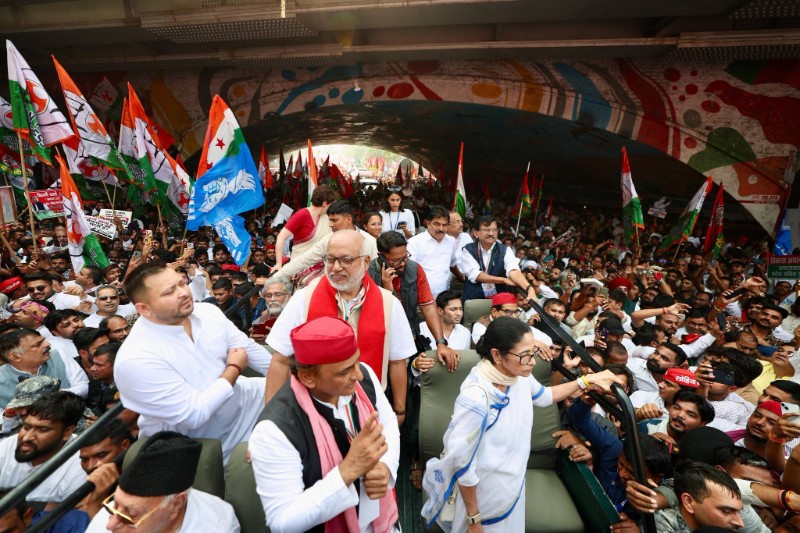
Delhi has witnessed several protests and demonstrations in recent weeks, with gatherings and associated security arrangements affecting prominent locations such as Jantar Mantar, Parliament Street and Connaught Place.
During the October 10 protest against Chief Election Commissioner Gyanesh Kumar, authorities imposed traffic restrictions and diversions across central Delhi.
Entry and exit gates at 45 Metro stations were also restricted at different times, affecting commuters and access to commercial areas.
The disruptions reportedly affected business activity in major markets, including Connaught Place, Khan Market, Janpath and Sadar Bazaar.
Traders reported reduced customer footfall and shop closures during the festive season.
Several traders’ associations subsequently called for restrictions on large-scale demonstrations in central commercial areas and proposed establishing a permanent protest zone outside the city.
They cited traffic congestion, difficulties for customers accessing markets and financial losses among their concerns.
Support Our Journalism
We cannot do without you.. your contribution supports unbiased journalism
IBNS is not driven by any ism- not wokeism, not racism, not skewed secularism, not hyper right-wing or left liberal ideals, nor by any hardline religious beliefs or hyper nationalism. We want to serve you good old objective news, as they are. We do not judge or preach. We let people decide for themselves. We only try to present factual and well-sourced news.
Support objective journalism for a small contribution.