 Pakistan Floods
Pakistan floods: Six month wait for water to recede, warn relief agencies
New York: Millions of people in Pakistan are still deeply affected by catastrophic flooding which “is not going anywhere”, UN relief agencies said on Tuesday.
Close to eight million people have been displaced by the disaster and the UN along with the authorities and partners have continued to race to reach affected populations with desperately needed relief items.
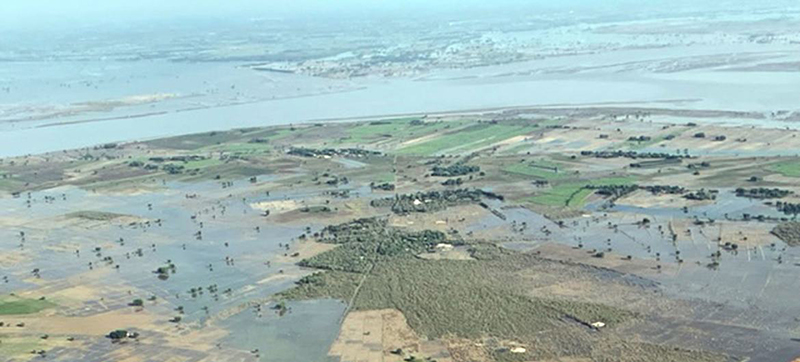
Southern Sindh province is still in crisis, with many areas still under water.
To date, more than 1,500 people have been killed, including 552 children.
“We don’t have enough food, we don’t have shelter, and still even the kind of healthcare that is required is not available,” said Gerida Birukila, UN Children’s Fund (UNICEF) Pakistan Chief of Field Office in Balochistan, another of the worst-hit provinces.
Roads and bridges swept away
In a fresh appeal for international support, the UNICEF worker described desperate scenes.
“Roads and bridges have been washed away; I’ve just come from the field and the water is not going anywhere,” Ms. Birukila continued, speaking via Zoom from Quetta.
As had been feared, life-threatening illness and disease have now spread among displaced communities, including cerebral malaria, for which there is no available medicine.
Please, give me clothes
“There is no shelter...people don’t even have clothing,” Ms. Birukila continued. “One lady asked me, ‘Please, give me some clothing, I ran away two weeks ago.’ She is still wearing the same dress she wore two weeks ago because she cannot change. You just run with what you have on your back.”
Echoing the deep concern among first-responders, the UN refugee agency, UNHCR, noted that 7.6 million people in Pakistan have been displaced by the floods, with nearly 600,000 living in relief sites.
Massive aid operation
The UN agency has coordinated logistics as part of a plan to transport more than 1.2 million relief items to local authorities in the most flood-affected areas. To date, it has delivered more than one million life-saving items to authorities for distribution.
“Many parts of the country, especially in the southern province of Sindh, remain underwater, as well as … parts of eastern Balochistan,” said UNHCR spokesperson Babar Baloch, adding that officials have warned that it could take “up to six months for floodwaters to recede” in the hardest-hit areas.
Afghans in danger zone
There are also concerns for Pakistan’s 1.3 million registered Afghan refugees; an estimated 800,000 live in more than 45 “calamity hit” districts out of 80 affected locations, UNHCR said, noting that four of the worst-hit districts in Balochistan, Khyber Pakhtunkhwa and Sindh provinces host the highest number of refugees.
To help them, UNHCR and partners have provided emergency cash assistance to hundreds of vulnerable refugee families, supplementing the Government’s monsoon response.
“People are being displaced. They are looking out and they just tell you, ‘That used to be my house, this used to be the school,’ but what you can see is just water and water,” said UNICEF’s Ms. Birukila.
Support Our Journalism
We cannot do without you.. your contribution supports unbiased journalism
IBNS is not driven by any ism- not wokeism, not racism, not skewed secularism, not hyper right-wing or left liberal ideals, nor by any hardline religious beliefs or hyper nationalism. We want to serve you good old objective news, as they are. We do not judge or preach. We let people decide for themselves. We only try to present factual and well-sourced news.
Support objective journalism for a small contribution.