


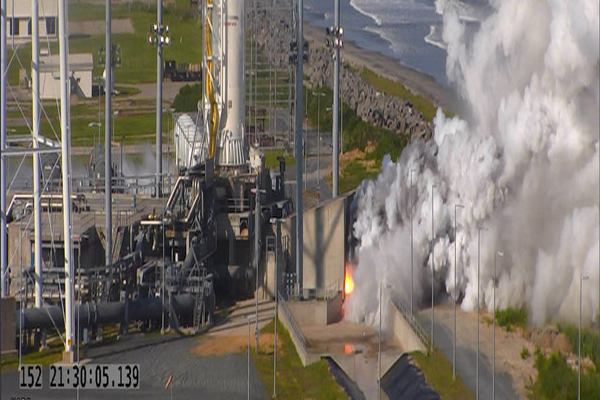
Orbital ATK conducts test of Antares first stage
Initial indications suggest that the test was fully successful, and the Antares engineering team will review test data over the next two weeks to confirm that all test parameters were met. The confirmation of a successful test will clear the way for Orbital ATK to resume cargo resupply services to the International Space Station from NASA’s Wallops Flight Facility in Virginia, currently scheduled for July.
“Early indications show the upgraded propulsion system, core stage and launch complex all worked together as planned,” said Mike Pinkston, Orbital ATK General Manager and Vice President, Antares Program. “Congratulations to the combined NASA, Orbital ATK and Virginia Space team on a successful test.”
The primary goal of the test was to verify the functionality of the integrated first stage, including new engines, modified Stage 1 core, avionics, thrust vector control and pad fueling systems in an operational environment, read the NASA website.
The test also met a number of operational milestones including full propellant loading sequence, launch countdown and engine ignition and shut down commands, as well as multiple throttle settings including full engine power. Additionally, the test validated the launch pad’s operation, including propellant tanking and the use of the water deluge system to protect the pad from damage and suppress noise.
Support Our Journalism
We cannot do without you.. your contribution supports unbiased journalism
IBNS is not driven by any ism- not wokeism, not racism, not skewed secularism, not hyper right-wing or left liberal ideals, nor by any hardline religious beliefs or hyper nationalism. We want to serve you good old objective news, as they are. We do not judge or preach. We let people decide for themselves. We only try to present factual and well-sourced news.
Support objective journalism for a small contribution.


