


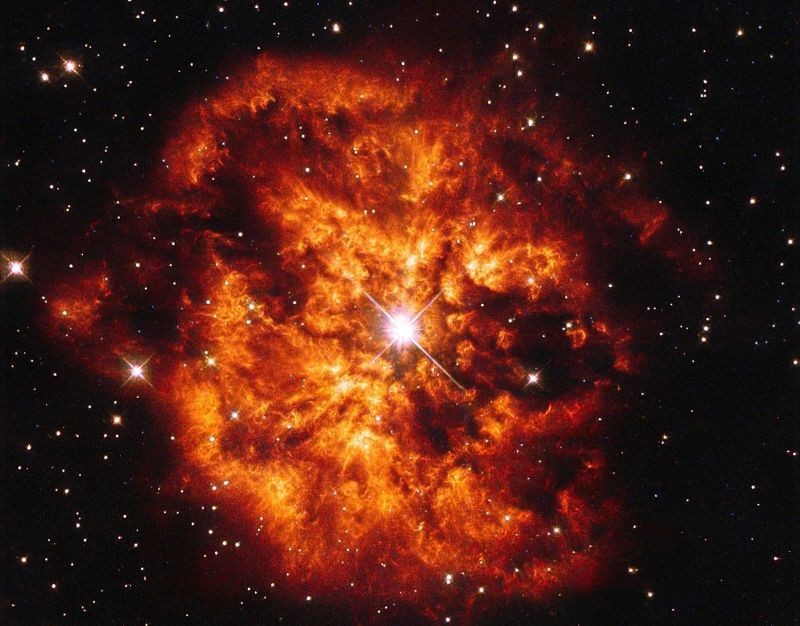
NASA Hubble captures stunning image of Wolf-Rayet Star Hen 2-427, surrounding nebula M1-67
A breathtaking new image from the NASA/ESA Hubble Space Telescope reveals a rare cosmic pairing: the powerful star Hen 2-427, also known as WR 124, and the glowing nebula M1-67 that surrounds it.
Both objects are located in the Sagittarius constellation, roughly 15,000 light-years from Earth.
Super-hot 🔥
— Hubble (@NASAHubble) February 12, 2026
Hubble captured a cosmic couple: The blazing star WR 124 and the nebula surrounding it. At 15,000 light-years away, they call the constellation Sagittarius home.
Hot clumps of gas are being ejected by the star at over 93,210 mph: https://t.co/G9S00KZzyL pic.twitter.com/yBkNHJiBEe
At the center of the image, Hen 2-427 shines intensely, while clumps of hot gas are being ejected into space at speeds exceeding 93,000 miles per hour (150,000 kilometers per hour). This dramatic expulsion of matter creates a striking spectacle in the surrounding nebula.
What kind of star is Hen 2-427?
Hen 2-427 is classified as a Wolf-Rayet star, a rare and massive type of star named after astronomers Charles Wolf and Georges Rayet.
Wolf-Rayet stars are known for being extremely hot and shedding enormous amounts of matter into space through strong stellar winds.
A young and vibrant nebula
The nebula M1-67, which envelops Hen 2-427, is estimated to be no older than about 10,000 years, a relatively short time in astronomical terms.
Despite its youth, it forms a spectacularly beautiful halo of gas and dust around the star, glowing brightly in the Hubble image, according to NASA.
This cosmic duo offers astronomers a vivid glimpse into the life cycle of massive stars and the dramatic processes that shape nebulae in our galaxy.
Support Our Journalism
We cannot do without you.. your contribution supports unbiased journalism
IBNS is not driven by any ism- not wokeism, not racism, not skewed secularism, not hyper right-wing or left liberal ideals, nor by any hardline religious beliefs or hyper nationalism. We want to serve you good old objective news, as they are. We do not judge or preach. We let people decide for themselves. We only try to present factual and well-sourced news.
Support objective journalism for a small contribution.


