


Near-record warm temperatures fuel deadly, costly weather events in 2017 – UN
New York, Jan 19 (JEN): The upward trend in global temperatures marked by record-shattering warmth in 2015 and 2016 kept pace last year, with the United Nations weather agency warning Thursday that continued pressure on the Arctic in 2017 will have “profound and long-lasting repercussions on sea levels, and on weather patterns in other parts of the world.”
“The long-term temperature trend is far more important than the ranking of individual years, and that trend is an upward one,” Petteri Taalas, Secretary-General of the World Meteorological Organization (WMO) said.
A WMO analysis showed that while measuring 1.2°C above the preindustrial era that 2016 holds the warmest year record, 2017, which measured approximately 1.1° C above the pre-industrial era, was the warmest year without an El Niño, which can boost global annual temperatures.
Describing the accelerating pace of climate change as “an existential threat to the planet,” the Secretary-General’s Special Representative for Disaster Risk Reduction, Robert Glasser, said, “A three-year streak of record hot years, each above 1° Celsius, combined with record-breaking economic losses from disasters in 2017 should tell us all that we are facing an existential threat to the planet which requires a drastic response.
“We are getting dangerously close to the limit of the 2°C temperature rise set out in the Paris Agreementand the desired goal of 1.5° will be even more difficult to maintain under present levels of greenhouse gas emissions,” he underscored.
Recording the same global average temperatures, 2017 and 2015 were virtually indistinguishable because the difference is less than one hundredth of a degree, which is less than the statistical margin of error.
“Seventeen of the 18 warmest years on record have all been during this century, and the degree of warming during the past three years has been exceptional,” Taalas pointed out, stressing: “Arctic warmth has been especially pronounced and this will have profound and long-lasting repercussions on sea levels, and on weather patterns in other parts of the world.”
The globally averaged temperature in 2017 was about 0.46°C above the 1981-2010 long-term average of 14.3°C – a 30-year baseline used by national meteorological and hydrological services to assess averages and variability of key climate parameters, which are important for climate-sensitive sectors, such as water management, energy, agriculture and health.
Climate also has a naturally occurring variability due to phenomena such as El Niño, which has a warming influence, and La Niña, which has a cooling influence.
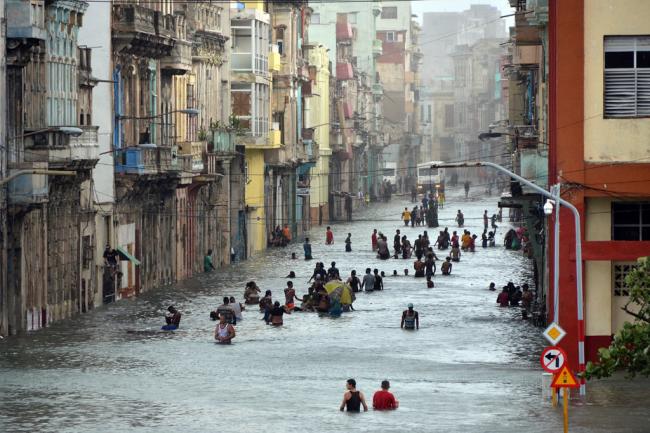
“Temperatures tell only a small part of the story. The warmth in 2017 was accompanied by extreme weather in many countries around the world,” Taalas continued, saying that the United States had its most expensive year ever in terms of weather and climate disasters, “whilst other countries saw their development slowed or reversed by tropical cyclones, floods and drought.
In March, WMO will issue its 2017 full Statement on the State of the Climate, which will provide a comprehensive overview of temperature variability and trends, high-impact events, and long-term indicators of climate change such as increasing carbon dioxide concentrations, Arctic and Antarctic sea ice, sea level rise and ocean acidification.
The final statement will include information submitted by a wide range of UN agencies on human, socio-economic and environmental impacts as part of a drive to provide a more comprehensive, UN-wide policy brief for decision makers and the Sustainabel Development Goals (SDGs).
Glasser expressed concern that climate change, combined with poverty, eco-systems destruction and inappropriate land use are pushing more people to leave home.
“We need increased levels of ambition to reduce greenhouse gas emissions combined with concrete actions to reduce disaster risk especially in least developed countries which contribute little to climate change,” he underscored.
Photo: UNOCHA EFE/Rolando Pujol
Support Our Journalism
We cannot do without you.. your contribution supports unbiased journalism
IBNS is not driven by any ism- not wokeism, not racism, not skewed secularism, not hyper right-wing or left liberal ideals, nor by any hardline religious beliefs or hyper nationalism. We want to serve you good old objective news, as they are. We do not judge or preach. We let people decide for themselves. We only try to present factual and well-sourced news.
Support objective journalism for a small contribution.


