


 East Africa
East African countries better prepared, but desert locust threat ‘not over’
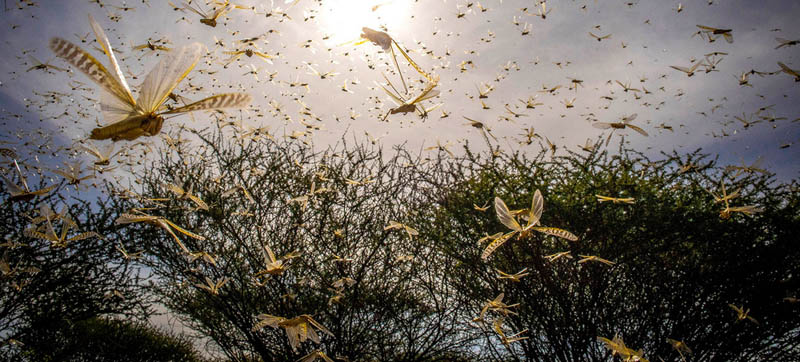
New York: Action to control unprecedented desert locust infestations in the Horn of Africa last year has protected crops and livelihoods, but funding is needed to sustain operations against new incursions, the Food and Agriculture Organization (FAO) said on Tuesday.
The UN agency is seeking $38 million to continue work in Ethiopia, Kenya, Somalia and Sudan.
Without this support, 28 aircraft that patrol the skies to spot and spray swarms could be grounded as early as March.
No time for complacency
Dominique Burgeon, FAO’s Director of Emergencies and Resilience, said the huge desert locust swarms in 2020, some as wide as 60 kilometres, had not been seen in decades, threatening food security in a region where many were already going hungry.
Surveillance and response led to 1.6 million hectares of land being treated. As a result, more than three million tonnes of cereals, valued at approximately $940 million, were protected: enough to feed 21 million people for a year.
“We can say that huge progress has been made, capacities of the countries have been tremendously augmented…but yet the situation is not over”, he told journalists.
“We have made a huge effort, we are much better prepared, but we should not be complacent. We should not relax.”
Swarms arriving ‘nearly every day’
Keith Cressman, FAO’s Senior Locust Forecasting Officer, said Cyclone Gati in December brought heavy rains, creating the conditions for new swarms to form in eastern Ethiopia and central Somalia.
Locusts began migrating south to northern Kenya and southern Ethiopia when the waters dried up, as experts had predicted.
“We had forecasted this in October. We had provided early warning to both countries to expect this shortly after mid-December, and that’s indeed what happened”, he said. “And since then, they have been arriving nearly every day.”
The locusts are young now but will mature, and reproduce, in the coming months. FAO anticipates a new generation will emerge in early April, coinciding with seasonal rains and the planting period in Kenya and southern Ethiopia.
Desert locusts are also breeding further north, on Somalia’s coastline on the Gulf of Aden, with new swarms likely to begin forming in late February.
“This is a cause of concern, and this is also why it’s extremely important that the control operations…are not disrupted”, said Mr. Cressman.
Support Our Journalism
We cannot do without you.. your contribution supports unbiased journalism
IBNS is not driven by any ism- not wokeism, not racism, not skewed secularism, not hyper right-wing or left liberal ideals, nor by any hardline religious beliefs or hyper nationalism. We want to serve you good old objective news, as they are. We do not judge or preach. We let people decide for themselves. We only try to present factual and well-sourced news.
Support objective journalism for a small contribution.


