


 Sanitation Crisis
Women and girls bear brunt of global water and sanitation crisis
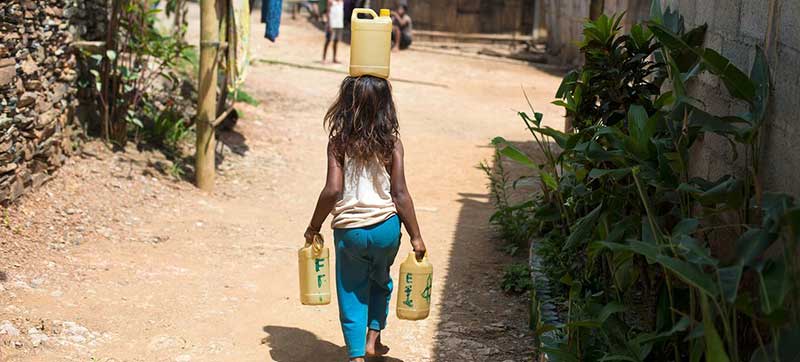
Women and girls are primarily responsible for water collection in seven out of 10 households that lack supply, the UN Children’s Fund (UNICEF) and the World Health Organization (WHO) said in a new report published on Thursday.
The study provides the first in-depth analysis of gender inequalities in drinking water, sanitation, and hygiene (WASH) in households, revealing that women and girls bear the brunt of the global water and sanitation crisis.
Billions lack access
Globally, 2.2 billion people still do not have safely managed drinking water at home, and some 3.4 billion do not have access to safe sanitation. Around two billion people cannot wash their hands with soap and water at home.
The report found that women are most likely to be responsible for fetching water for households, and girls are nearly twice as likely as boys.
Dangerous journeys
Women and girls generally make longer journeys to fetch water, causing them to lose out on education, work, and leisure time. They also face risks of physical injury and dangers on the way.
Tweet URL
“Every step a girl takes to collect water is a step away from learning, play, and safety,” said Cecilia Sharp, UNICEF Director of WASH and CEED, which refers to the agency’s work in climate, energy, environment, and disaster risk reduction.
“Unsafe water, toilets, and handwashing at home robs girls of their potential, compromises their well-being, and perpetuates cycles of poverty,” she added.
Nearly two billion people worldwide live in households without water supplies on the premises, according to the report. In most of these households, seven out of 10, women and girls aged 15 and older are mainly responsible for fetching water, compared to men and boys.
Compromising privacy and dignity
Women and girls also are more likely to feel unsafe using a toilet outside the home and disproportionately suffer the impact of lack of hygiene.
More than half a billion people worldwide still share sanitation facilities with other households, compromising women’s and girls’ privacy, dignity, and safety.
Recent surveys from 22 countries show that among households with shared toilets, women and girls are more likely than men and boys to feel unsafe walking alone at night and face sexual harassment and other safety risks.
Furthermore, inadequate WASH services increase health risks for women and girls and limit their ability to safely and privately manage their periods.
Dr. Maria Neira, Director of WHO’s Environment, Climate Change and Health Department, noted that 1.4 million people die each year due to inadequate access to water, sanitation, and hygiene.
“Women and girls not only face WASH-related infectious diseases, like diarrhoea and acute respiratory infections, they face additional health risks because they are vulnerable to harassment, violence, and injury when they have to go outside the home to haul water or just to use the toilet,” she said.
More action needed
The report also highlighted global progress towards ensuring people everywhere have access to WASH services.
Between 2015 and 2022, household access to safely managed drinking water increased from 69 per cent to 73 per cent. The same period also saw safely managed sanitation increase from 49 per cent to 57 per cent and basic hygiene services rise from 67 per cent to 75 per cent.
However, the UN agencies warned that greater efforts are needed to achieve the Sustainable Development Goal (SDG) target for universal access to safely managed WASH services by 2030.
Further action is also required to ensure that progress contributes towards gender equality.
Support Our Journalism
We cannot do without you.. your contribution supports unbiased journalism
IBNS is not driven by any ism- not wokeism, not racism, not skewed secularism, not hyper right-wing or left liberal ideals, nor by any hardline religious beliefs or hyper nationalism. We want to serve you good old objective news, as they are. We do not judge or preach. We let people decide for themselves. We only try to present factual and well-sourced news.
Support objective journalism for a small contribution.


