


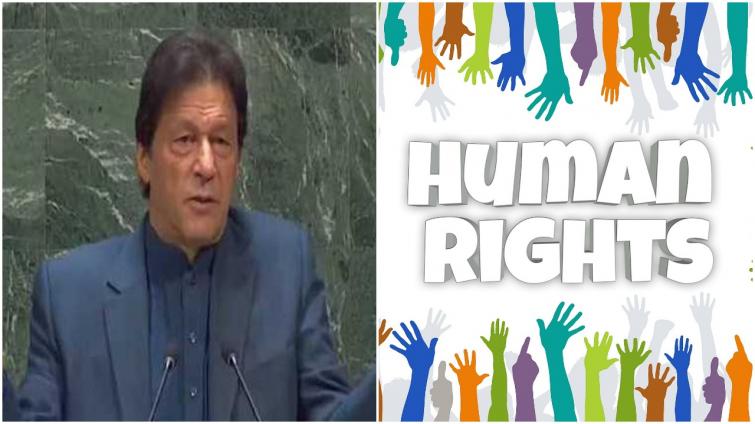
Weakest segments of society invisible, unheard: Human Rights Commission of Pakistan
Islamabad/IBNS: The Human Rights Commission of Pakistan (HRCP) notes that widespread social and economic marginalisation have left the weakest segments of society invisible and unheard.
HRCP’s honorary spokesperson I. A. Rehman has termed Pakistan’s human rights record in 2019 ‘greatly worrisome’, adding that the ongoing global pandemic ‘is likely to cast a long shadow on prospects for human rights.’
On the release of its flagship annual report, State of Human Rights in 2019, HRCP’s secretary-general Harris Khalique observed: "Last year will be remembered for systematic curbs on political dissent, the chokehold on press freedom, and the grievous neglect of economic and social rights."
"The 2019 report also offers standalone chapters on each federating unit and administered territories so that no area remains underreported or missed out," he added.
Pakistan has failed to protect its most vulnerable: reports of child labourers being sexually abused in mines surfaced in Balochistan, while news of young children being raped, murdered and dumped has become frighteningly common.
Women continued to bear the brunt of society’s fixation with ‘honour’, with Punjab accounting for the highest proportion of ‘honour’ crimes.
Equally, Pakistan does not protect those to whom it has a duty of care: prisoners in the country’s sorely overpopulated jails remain relegated to subhuman level.
Numerous journalists reported that it had become even more difficult to criticise state policy. Former HRCP chairperson Zohra Yusuf says that this, coupled with the erosion of social media spaces and a deliberate financial squeeze on the media, ‘led to Pakistan’s position slipping on the World Press Freedom Index.’
People continued to be reported ‘missing’ during the year. It is imperative that the government deliver on its commitment to criminalise enforced disappearances. Equally, the continued operation of internment centres cannot be justified on any grounds.
HRCP director Farah Zia said: "In the case of Balochistan and Khyber-Pakhtunkhwa)—both historically under-reported provinces—the acknowledgement of real issues and their political resolution is vital if the state is serious about strengthening the federation."
Religious minorities remained unable to enjoy the freedom of religion or belief guaranteed to them under the constitution. For many communities, this has meant the desecration of their sites of worship, the forced conversion of young women, and constant discrimination in access to employment.
While Pakistan witnessed the first-ever conviction of a former military ruler for high treason, constitutional compliance remains a major cause for concern.
For instance, Article 140-A has yet to be implemented effectively, given the prolonged delay in holding local body elections in Punjab, Khyber-Pakhtunkhwa and Balochistan.
The restoration of student unions and space for trade unions to function remain cause for concern.
Chairperson Dr Mehdi Hasan reaffirmed HRCP’s distress over the gross violations of human rights committed in Indian-held Kashmir since August 2019 and the imminent fallout of the situation on regional peace and stability.
Support Our Journalism
We cannot do without you.. your contribution supports unbiased journalism
IBNS is not driven by any ism- not wokeism, not racism, not skewed secularism, not hyper right-wing or left liberal ideals, nor by any hardline religious beliefs or hyper nationalism. We want to serve you good old objective news, as they are. We do not judge or preach. We let people decide for themselves. We only try to present factual and well-sourced news.
Support objective journalism for a small contribution.


