


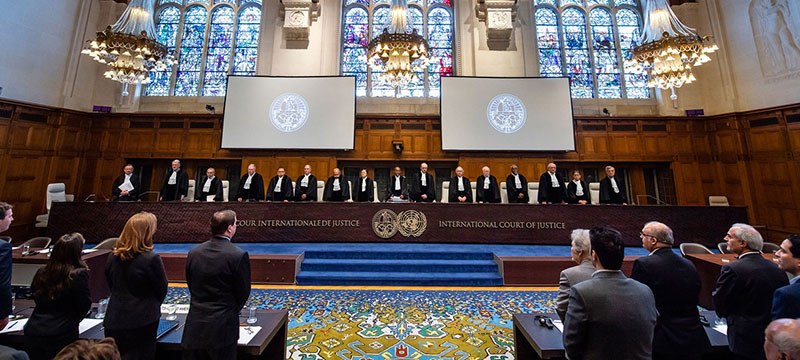
 Hilary Charlesworth
Veteran Australian judge Hilary Charlesworth elected to the International Court of Justice
New York: The United Nations General Assembly and Security Council elected a new judge this Friday to sit on the International Court of Justice (ICJ), the principal judicial organ of the UN.
Hilary Charlesworth, from Australia, will replace James Crawford, also from Australia, who died in May and had been on the Court since 2014. She will serve the remainder of Mr. Crawford’s nine-year term, which has some two years remaining.
Professor Charlesworth defeated Linos-Alexander Sicilianos, from Greece, with an absolute majority of votes, becoming the fifth women judge ever at the ICJ.
She is well-known as a preeminent scholar of international law, and has also served as a judge ad hoc for the Court in two contentious rulings of the ICJ: Arbitral Award of 3 October 1899 (Guyana v. Venezuela) and Whaling in the Antarctic (Australia v. Japan: New Zealand intervening).
Court of courts
The Court is composed of 15 judges, who are elected by an absolute majority in both the General Assembly (97 votes) and Security Council (8 votes). The timing of elections is staggered so that the General Assembly elects a third of the Court once every three years.
According to the Court's Statute, its judges must be chosen by coordinated actions of both the Council and the General Assembly, with the date of elections determined by the Council.
Judges are chosen on the basis of their qualifications, not their nationality, but no two judges can be from the same country. Effort is also taken to ensure that the principal legal systems of the world are reflected in the composition of the court.
Established in 1945, and based in The Hague in the Netherlands, the ICJ – which is also known as the World Court – settles legal disputes between States and gives advisory opinions on legal questions that have been referred to it by other authorized UN organs.
The Court has a dual mission, consisting, on the one hand, of settling disputes of a legal nature submitted to it by States in accordance with international law and, on the other hand, of giving advisory opinions on legal questions which may be submitted to it.
An alternative to armed conflict
In an interview with UN News, in New York, the Registrar of the ICJ left a clear message to Member States: it is always better for them to approach the Court to settle a dispute rather than launching into armed conflict.
Philippe Gautier, from Belgium, has held the post of Registrar, the head of the Secretariat which assists the Court, since 2019.
Mr. Gautier said the Court currently has 15 cases on the docket, which give “a snapshot of problems and issues of concern for the international community.”
The main area, he explained, is delimitation of maritime or land boundaries, with five cases.
“It's very sensitive. For a 10 square kilometer, countries may go to extreme solutions sometimes. It is always better to settle that peacefully”, Mr. Gautier said.
Human Rights is also very prominent, with cases regarding the move of the United States’ embassy to Jerusalem, a case brought by Palestine, or the alleged violation of the Convention Against Genocide, a case brought by Gambia against Myanmar.
“The whole process of peaceful settlement of dispute means that, instead of waging a war, you go to an international court to settle peacefully your dispute”, the Registrar explained. “That is something of interest for every human being, and that is not so well known.”
Support Our Journalism
We cannot do without you.. your contribution supports unbiased journalism
IBNS is not driven by any ism- not wokeism, not racism, not skewed secularism, not hyper right-wing or left liberal ideals, nor by any hardline religious beliefs or hyper nationalism. We want to serve you good old objective news, as they are. We do not judge or preach. We let people decide for themselves. We only try to present factual and well-sourced news.
Support objective journalism for a small contribution.


