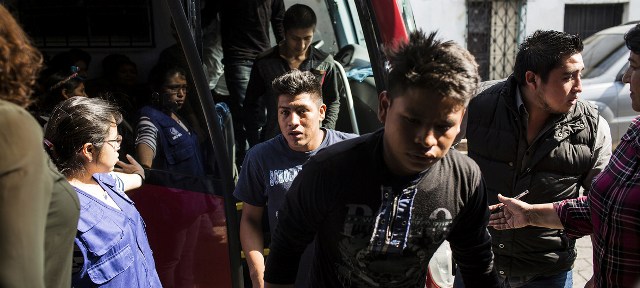
US and Mexico child deportations drive extreme violence and trauma: UNICEF
New York,m Aug 16 (IBNS): The many life-threatening dangers faced by children from Central America who are being deported from the United States of America and Mexico, are highlighted in a new report from United Nations Children’s Fund (UNICEF) on Thursday, which also draws attention to the traumatic consequences of family separation by migration authorities.
In the first 6 months of this year, almost 25,000 women and children from northern Central America were deported after arriving in Mexico and the US, in search of asylum or a better life.
The study, Uprooted in Central America and Mexico, identifies poverty and violence as two of the main reasons why children are leaving their homes in Central America, and attempting to migrate to the US and Mexico, mainly from El Salvador, Guatemala and Honduras. Once the children are sent back to their country of origin, these threats only increase.
Central American countries are some of the poorest in the Western Hemisphere: almost three quarters of Honduran children are living in poverty. Many families take out loans to finance their departure, and, when they are sent back, children can find themselves homeless or unable to pay for basic necessities.
For those who fled their homes to escape gang violence (endemic in communities across northern Central America, with hundreds murdered every year), a return can mean a heightened risk of attack. In fear of their lives, many avoid their towns and villages and end up internally-displaced.
The trauma suffered by children held in detention by migration authorities, and separated from their families, can have a negative effect on the child’s long-term development, said the agency report.
María Cristina Perceval, UNICEF Regional Director for Latin America and the Caribbean, urged governments to consider the needs of children before deporting them, and to protect and reintegrate them once they return home: “Millions of children in the region are victims of poverty, indifference, violence, forced migration and the fear of deportation. Being returned to impossible situations makes it more likely that they will migrate again.”
The report makes a series of recommendations to keep refugee and migrant children safe. These include allowing them to be with their families and supporting alternatives to detention; safeguarding their wellbeing, and solving the problems that force them to leave home in the first place.
UNICEF/Tanya Bindra
Support Our Journalism
We cannot do without you.. your contribution supports unbiased journalism
IBNS is not driven by any ism- not wokeism, not racism, not skewed secularism, not hyper right-wing or left liberal ideals, nor by any hardline religious beliefs or hyper nationalism. We want to serve you good old objective news, as they are. We do not judge or preach. We let people decide for themselves. We only try to present factual and well-sourced news.
Support objective journalism for a small contribution.