


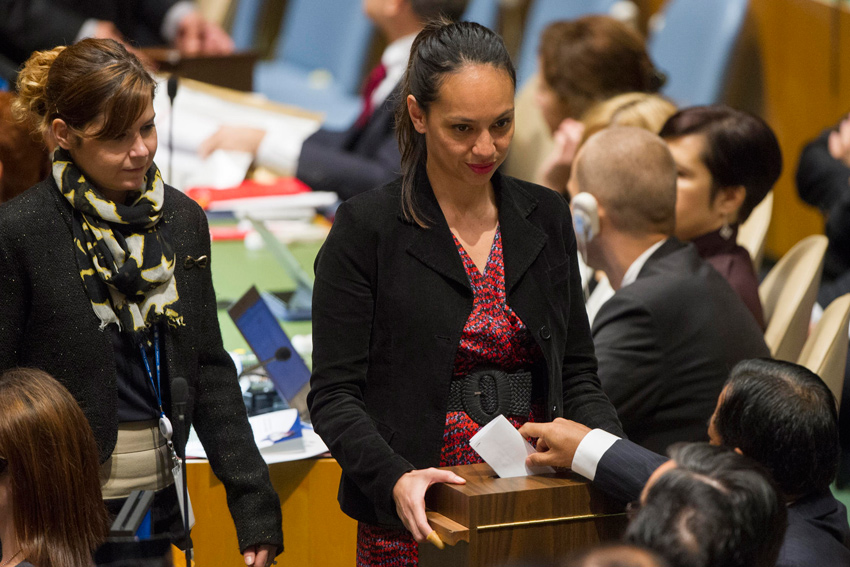
UN General Assembly voting to elect non-permanent Security Council members
The new members will take up their seats on 1 January 2015 and will serve on the Council until 31 December 2016.
The Assembly has now moved into a third round of balloting to choose either Spain or Turkey to fill the remaining seat on the Council open to the Western European and Other States Group.
The five seats available for election in 2014, distributed regionally, are: one seat for the African Group (currently held by Rwanda); one seat for the Group of Asia- Pacific Group (currently held by the Republic of Korea); one seat for the Group of Latin American and Caribbean States, (currently held by Argentina); and two seats for the Western European and Others Group (currently held by Australia and Luxembourg).
Lithuania will maintain for another year, the seat for the Eastern European Group.
The respective contenders for the upcoming vacancies were Angola (Africa), Malaysia (Asia-Pacific) and Venezuela (Latin America and the Caribbean). There were three nations vying for the two seats designated for Western European and Other States – New Zealand, Spain and Turkey.
New Zealand was selected in the first round of voting.
The five permanent Council members, which each wield the power of veto, are China, France, Russia, the United Kingdom and the United States. Along with Lithuania, the non-permanent members that will remain on the Council until the end of 2015 are Chad, Chile, Jordan, and Nigeria.
Under the UN Charter, the Security Council has primary responsibility for the maintenance of international peace and security. Each of the Council’s members has one vote. Under the Charter, all UN Member States are obligated to comply with Council decisions.
The Security Council takes the lead in determining the existence of a threat to the peace or act of aggression. It calls upon the parties to a dispute to settle it by peaceful means and recommends methods of adjustment or terms of settlement. In some cases, the Security Council can resort to imposing sanctions or even authorize the use of force to maintain or restore international peace and security.
The Security Council also recommends to the General Assembly the appointment of the Secretary-General and the admission of new Members to the United Nations. And, together with the General Assembly, it elects the judges of the International Court of Justice.
Image: UN Photo/Mark Garten
Support Our Journalism
We cannot do without you.. your contribution supports unbiased journalism
IBNS is not driven by any ism- not wokeism, not racism, not skewed secularism, not hyper right-wing or left liberal ideals, nor by any hardline religious beliefs or hyper nationalism. We want to serve you good old objective news, as they are. We do not judge or preach. We let people decide for themselves. We only try to present factual and well-sourced news.
Support objective journalism for a small contribution.


