October 03, 2026 08:00 pm (IST)

Follow us:


UN concerned over nutritional deficits in some countries
New York, Apr 2 (IBNS): The United Nations Food and Agriculture Organization (FAO) paints a picture of persistent nutrition problems due to vitamin and mineral deficiencies, and stunted growth in its latest snapshot of the Europe and Central Asia.
On the eve of its biennial Regional Conference for Europe – in Bucharest, Romania – FAO concludes that although caloric intake in the 53-country region should see hunger fall to less than 1 per cent by 2050, nutrition problems continue in some of the countries today.
“Caloric intake as a measure of undernourishment is currently not the major problem,” reveals the document.
For many countries a more significant problem is the lack of adequate micronutrient intake and the sub-optimal quality of diets, often ranking lower than other regions of the world.
Raimund Jehle, Senior Field Programme Officer in FAO’s Regional Office for Europe and Central Asia spells out that many diets are deficient in micronutrients, “like iron, copper or vitamins.”
Across the region, two countries have yet to reach targets aimed at cutting under-nutrition in half by 2015: the first 2001 Millennium Development Goal and the 1996 World Food Summit goal.
Additionally, 5 per cent of undernourishment still exists in three countries today and a comparatively high rate of childhood stunting is found in two countries.
In the Caucasus and Central Asia, stunted children under age five is more than three times higher than in the European Commonwealth of Independent States (CIS) – where the figure stands at 6 per cent.
“Undernourishment is related to the status of poverty,” said Jehle.
While in some countries the poorest people obtain 73 per cent of their daily calories from cereals and only 10 per cent from dairy or meat products, those with the highest income have more balanced diets – with 48 per cent of calories coming from cereals and 29 per cent from animal products.
In a positive trend for improved dietary diversity and quality, the paper notes that fruit and vegetable production in Caucasus and Central Asia is on the rise.
Turning to obesity, FAO notes that almost 48 per cent of people in the Caucasus and Central Asia countries, and more than 50 per cent in both the European CIS and South-eastern European countries were overweight or obese by World Health Organization (WHO) standards.
The paper cautions the risk of overweight as increasing diet-related diseases and straining healthcare facilities, particularly in countries with fewer financial resources.
Focusing on the most food-insecure group of countries in Caucasus and Central Asia, FAO elaborated that despite recent increases in agricultural production, all countries except Uzbekistan continue to import agricultural products.
High reliance on imports makes these countries more vulnerable to fluctuations in international prices, or to the level of their export earnings.
At the consumer level, an average of 30 per cent of household budgets in these countries is spent on food – compared to 10 per cent in Germany or 13 per cent in Czech Republic – with the poorest families spending up to 70 per cent of their income.
Looking forward, the paper projects that prospects for human health and development across the 18 countries it covered depend largely on the policy choices of national Governments.
The central recommendation is clear: “The focus of governments needs to be on developing and implementing a comprehensive approach to the revival and development of the agricultural and rural sector.”
The paper recommends some key ingredients for national recipes to improve food security and nutrition including, among others, a policy focus on smallholder producers in order to reduce rural poverty, increase output and improve agricultural competitiveness; shifting away from extensive production and reliance on one or two commodities; overall economic growth; avoiding consumer subsidies and price controls; trade and international cooperation; and a strong science and technology system that stimulates agricultural innovation.
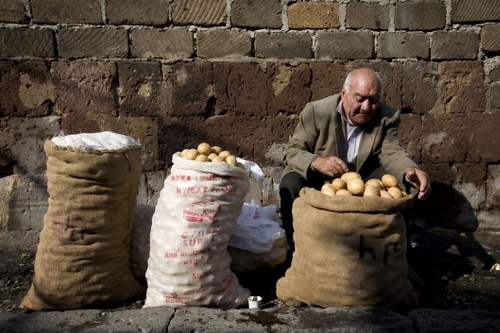
(A man sells potatoes in the street outside the central market in Yerevan, Armenia. Photo: FAO/Johan Spanner)
Support Our Journalism
We cannot do without you.. your contribution supports unbiased journalism
IBNS is not driven by any ism- not wokeism, not racism, not skewed secularism, not hyper right-wing or left liberal ideals, nor by any hardline religious beliefs or hyper nationalism. We want to serve you good old objective news, as they are. We do not judge or preach. We let people decide for themselves. We only try to present factual and well-sourced news.
Support objective journalism for a small contribution.



Latest Headlines
UAE calls Flydubai cockpit attack a ‘terrorist act’; Omani pilot tried to take control
Sat, Oct 03 2026
flydubai cockpit attack: Deleted posts expose Omani co-pilot’s views on women, alleged extremist past
Sat, Oct 03 2026
flydubai cockpit horror: Omani co-pilot Hamam al-Hammami attacked Captain Smit Machchhar with crash axe, tried to seize control
Sat, Oct 03 2026
flydubai temporarily suspends all Israel flights after co-pilot’s alleged cockpit attack, crash attempt
Sat, Oct 03 2026
Grounded in Oman over ‘radical views’, then hired by flydubai: What we know about Omani pilot Hamam al-Hammami
Sat, Oct 03 2026
Flydubai co-pilot who stabbed Smit Machchhar identified, was banned from flying by Oman due to suspected extremism: Report
Sat, Oct 03 2026
UK-Iranian national arrested over RAF Fairford terror plot probe
Fri, Oct 02 2026