UN agency calls on global clothing brands to help Cambodian manufacturers absorb wage hike
The new minimum wage of $128 per month, which came into effect on 1 January 2015, is projected by the International Labour Organization (ILO) to increase overall average wages in the garment industry – which include bonuses and overtime – from $183 to $217 per month, increasing factories’ wage bills by approximately 18.7 per cent.
“It is important that all sides work together to ensure Cambodia’s garment industry remains economically viable,” said Maurizio Bussi, the ILO’s Country Director for Thailand, Cambodia and Lao PDR. “We call on the global brands to play their part. We have received encouraging signals that key buyers will honour the pledge they gave the Cambodian Government in September.”
The rise comes in the wake of other adjustments since 2012 that have seen the minimum wage increase from $61 per month. At the same time, the prices that Cambodian factories receive in their main markets have been stagnating or declining, with the United States Bureau of Labor Statistics calculating a 4.5 per cent drop in prices paid for apparel imports from Association of Southeast Asian Nations (ASEAN) countries since June 2012.
“Caught between these two forces, factories have seen a substantial fall in their operating margins over the past three years,” said Malte Luebker, the ILO’s Senior Regional Wage Specialist. “In principle, factories can respond by increasing efficiency, using measures that range from better work organization to energy conservation. However, our research shows that these gains are gradual and will only enable factories to cover a small share of the expected wage increase.”
For example, optimistic projections of labour productivity growth in the garment sector see room for roughly four per cent growth in 2015, which would enable factories to raise wages by $7, to $190 per month, without eroding their margins. The expected wage increase to $217 per month is far higher than what can be generated through efficiency gains.
To cover the shortfall, and assuming other costs remained the same, the ILO estimates that global brands would need to pay Cambodian factories between 2.4 and three per cent more, adding about two cents to the production costs of t-shirts that can currently be made for 80 cents and that might retail for about $10.
On annual garment and footwear exports worth $6 billion, the small increase could generate additional revenue of $160 million to support the new wage levels.
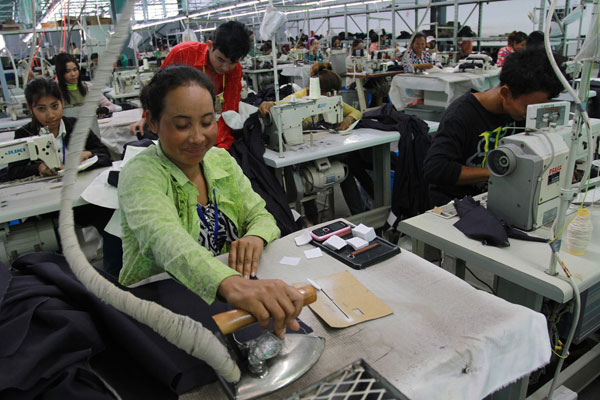
A woman irons fabric at a garments factory at the Sihanoukville Special Economic Zone, Phnom Penh, Cambodia. Photo: World Bank/Chhor Sokunthea
Support Our Journalism
We cannot do without you.. your contribution supports unbiased journalism
IBNS is not driven by any ism- not wokeism, not racism, not skewed secularism, not hyper right-wing or left liberal ideals, nor by any hardline religious beliefs or hyper nationalism. We want to serve you good old objective news, as they are. We do not judge or preach. We let people decide for themselves. We only try to present factual and well-sourced news.
Support objective journalism for a small contribution.