Ukraine: UN agency concerned by dire conditions facing civilians
“Living conditions, particularly for those with damaged homes or sheltering in bunkers and basements under the rubble of their houses or apartment buildings, have been exacerbated by cold weather and low temperatures,” said spokesman William Spindler of the Office of the UN High Commissioner for Refugees (UNHCR).
He added, “This has been further aggravated by restrictions to the movement of people and goods.”
Spindler said conditions in northern Donetsk and in Luhansk are particularly dire, with the supply of water and electricity often disrupted by shelling and rocket attacks.
Heavy shelling resulting in civilian deaths continues to be reported, especially around the town of Debaltseve, which was the scene of heavy fighting in January and February.
“The fighting makes the delivery of humanitarian aid to the many civilians trapped in the conflict areas extremely difficult. The scarcity of basic supplies, including food, fuel and medicines, has driven up prices of available supplies,” he said.
As part of the overall UN response to the situation in Ukraine, UNHCR co-leads the protection cluster and leads the shelter and non-food Items cluster.
The number of people internally displaced by the conflict in Ukraine has now reached the 1.1 million mark, while the total number of Ukrainians who have sought asylum, residence permits or other forms of legal stay in neighbouring countries now stands at 674,300, including 542,800 in Russia and 80,700 in Belarus.
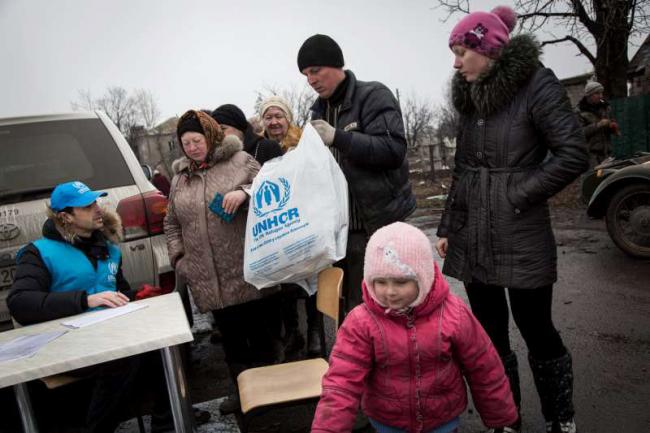
Despite security risks, UNHCR and its partners have delivered emergency non-food aid to some of the neediest civilians, including in areas that had been under frequent bombardment.
For the first time, aid reached Luhansk-Novopskov and Markivka, with local authorities that around 30 per cent of the displaced population there received assistance.
Distributions also took place in and around Debaltseve, where many houses were damaged or destroyed by fighting, and in the Donetsk region, where some 11,500 people in the Donetsk region received non-food humanitarian assistance from UNHCR in February.
“UNHCR is continuing to scale-up its presence in Donetsk city and is currently looking at the feasibility of an increased presence in Luhansk,” Spindler said.
Many civilians find themselves trapped in the conflict zone with freedom of movement extremely limited because of unavailability and unaffordability of transport, insecurity along exit routes and administrative barriers preventing civilians from reaching safety.
Ukrainian authorities have evacuated more than 11,000 people (including over 2,240 children and almost 350 people living with disabilities) from Donetsk and Luhansk but UNHCR reports that many civilians in conflict areas feel abandoned.
“Assistance to evacuees continues to fall far short of demand, particularly in the provision of accommodation, transport, information and maintaining family unity,” Spindler said.
Photo: UNHCR/A. McConnell
Support Our Journalism
We cannot do without you.. your contribution supports unbiased journalism
IBNS is not driven by any ism- not wokeism, not racism, not skewed secularism, not hyper right-wing or left liberal ideals, nor by any hardline religious beliefs or hyper nationalism. We want to serve you good old objective news, as they are. We do not judge or preach. We let people decide for themselves. We only try to present factual and well-sourced news.
Support objective journalism for a small contribution.