Trump announces 20% fee on cargo through Hormuz, declares US 'guardian' of strategic waterway
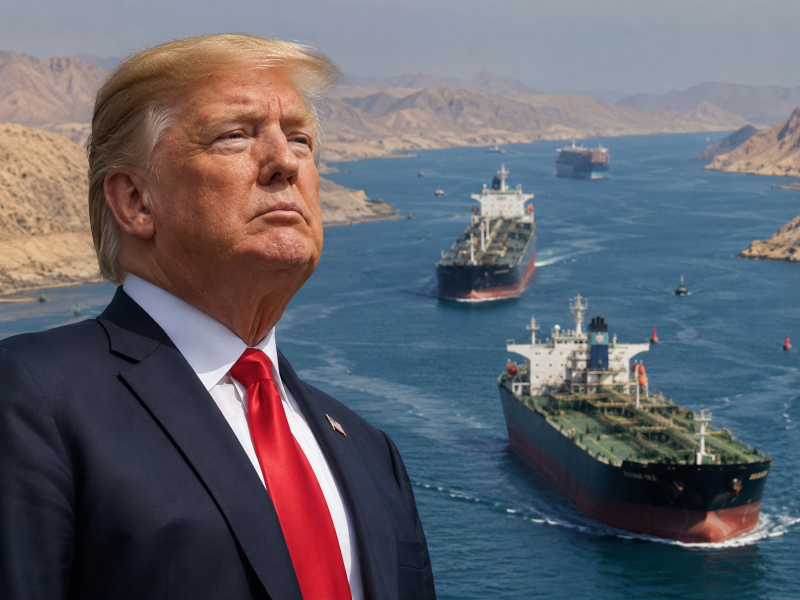
US President Donald Trump on Monday announced that the United States would impose a 20 per cent charge on all cargo shipped through the Strait of Hormuz, saying the fee would cover the costs of securing one of the world's busiest maritime trade routes.
In a post on his social media platform, Truth Social, Trump declared that the US would henceforth be known as "The Guardian of the Hormuz Strait."
"The USA will be, from this point forward, known as 'THE GUARDIAN OF THE HORMUZ STRAIT'... and, as a matter of FAIRNESS, will be reimbursed, at the rate of 20% on all cargo shipped, for any and all costs necessary to do the job of providing safety and security," Trump wrote.
He added that the process of implementing the policy would begin immediately.
US reinstates Iranian blockade
Trump also announced that Washington was reinstating what he called the "Iranian Blockade", saying it would prevent Iranian ships and vessels linked to Tehran from entering or leaving the country while allowing other nations unrestricted access to the strategic waterway.
"The Hormuz Strait is OPEN, and will remain OPEN, with or without Iran... All other countries will have fair and open use of the Strait," he said.
Hours earlier, in an interview with Fox News, Trump had said the US was effectively "taking over" the Strait of Hormuz.
"We're going to keep the strait, and we'll probably run it. We'll become the guardian of the strait... And we should be reimbursed for that," he said.
Iran rejects US move
Iran swiftly rejected Trump's announcement.
A spokesperson for Khatam Al-Anbiya, Iran's military command, said Tehran would "under no circumstances" allow the United States to interfere in the management of the strait, media reports said.
The spokesperson also warned Gulf countries that any cooperation with Washington over the waterway would be considered "an act of war."
Conflicting claims over control
The latest exchange came as the US and Iran continued military strikes for a second consecutive day, with both sides asserting control over the strategically vital passage.
While Trump was announcing the new policy, Iran's Persian Gulf Strait Authority (PGSA) said on X that it considered the Strait of Hormuz closed due to what it described as hostile US military actions.
According to the PGSA, commercial passage through the strait was currently "unfeasible" and permit approvals would resume only after stability returned.
It also reiterated that all transit permissions would be processed exclusively through its official website.
Dispute over legal authority
Iran argues that an interim peace agreement reached last month gives it the authority to regulate shipping through the strait and potentially levy transit charges.
The United States and several other countries reject that interpretation, maintaining that international law guarantees freedom of navigation through the waterway.
Washington has also been working on an alternative maritime route designed to reduce dependence on waters controlled by Iran.
Although Trump suggested last week that the interim agreement was effectively "over", mediators including Pakistan, Qatar and Egypt continue efforts to broker a permanent ceasefire.
Why the Strait of Hormuz matters
The Strait of Hormuz is one of the world's most critical maritime chokepoints, handling roughly 20 per cent of global oil and liquefied natural gas shipments.
The latest dispute traces back to Iran's blockade of the strait following US and Israeli strikes on Tehran on February 28, which killed then Supreme Leader Ali Khamenei and triggered the broader regional conflict.
Since then, control of the narrow waterway has remained at the centre of escalating tensions between Tehran and Washington.
Support Our Journalism
We cannot do without you.. your contribution supports unbiased journalism
IBNS is not driven by any ism- not wokeism, not racism, not skewed secularism, not hyper right-wing or left liberal ideals, nor by any hardline religious beliefs or hyper nationalism. We want to serve you good old objective news, as they are. We do not judge or preach. We let people decide for themselves. We only try to present factual and well-sourced news.
Support objective journalism for a small contribution.