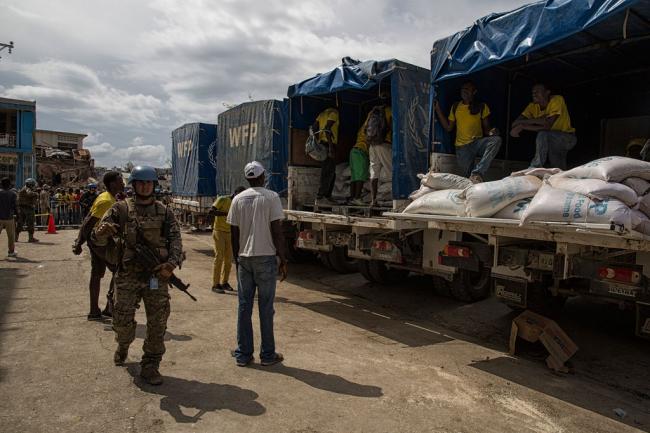
Three months after Hurricane Matthew, 1.5 million Haitians face hunger – UN agencies report
The UN World Food Programme released findings from a joint assessment conducted in December with the UN Food and Agricultural Organization (FAO) and Haiti’s National Coordination for Food Security (CNSA).
“The results of the assessment show the very positive impact of our collective efforts in the aftermath of Hurricane Matthew, but also the pressing need to continue and redirect assistance to new areas with higher levels of food insecurity, as well as initiate recovery interventions,” said Ronald Tran Ba Huy, WFP’s Representative in Haiti.
Findings showed that people in the southern areas of Grande-Anse and Sud, the hardest hit areas of the country, are better off. An estimated 400,000 face hunger and food insecurity, as compared with one million shortly after Matthew hit.
The Government and UN partners have been providing food to these areas, along with seeds, tools and financial resources.
Meanwhile, areas in the west – such as Artibonite, Nippes and La Gonave – even though the impact of the hurricane there was smaller, are worse off. The insecurity is blamed on cycles of drought and flooding which preceded the hurricane by three years.
Noting the uneven improvements as a result of the different interventions, Nathanaël Hishamunda, FAO’s representative in Haiti, said that there is now a need to “consolidate the gains made by working hand in hand with the Government, with the goal of reinforcing our interventions in the most vulnerable communities.”
Given the ongoing needs, the humanitarian community in Haiti has requested $113 million to support food security and agriculture for this year.
Photo: UN/MINUSTAH/Logan Abassi
Source: www.justearthnews.com
Support Our Journalism
We cannot do without you.. your contribution supports unbiased journalism
IBNS is not driven by any ism- not wokeism, not racism, not skewed secularism, not hyper right-wing or left liberal ideals, nor by any hardline religious beliefs or hyper nationalism. We want to serve you good old objective news, as they are. We do not judge or preach. We let people decide for themselves. We only try to present factual and well-sourced news.
Support objective journalism for a small contribution.