


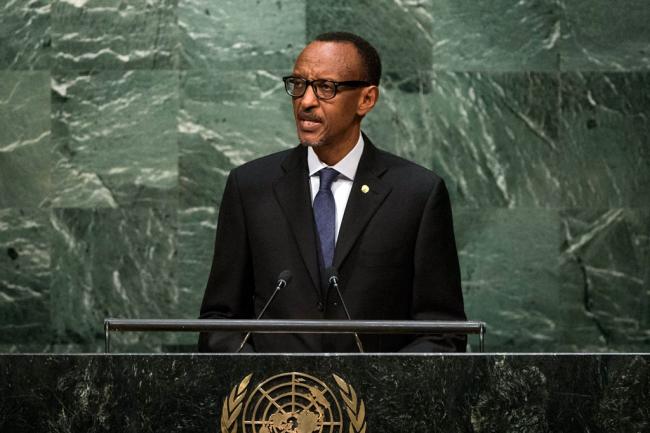
The only sustainable future is one that includes us all: Rwandan President
“Our task is to settle the future not the past. Change is coming and it is necessary. No one can manage it alone. And the Global Goals rightly recognize our mutual interdependence,”said Paul Kagame in his address to the Assembly’s annual General Debate, stressing that the ambitious 2030 Agenda for Sustainable Development had set out good commitments that must now be wholly kept.
“Building a community of shared purpose capable of doing so starts with a recognition of our equality,” he added.
The adoption by the General Assembly of the Global Goals marked a new era in international cooperation.
Ending extreme poverty was never going to be enough to fulfil the international community’s ambitions, he said, referring to the landmark Millennium Development Goals (MDGs), which the new targets will succeed.
“This new compact is about prosperity and it recognizes that the only sustainable future is one that includes all of us. It could hardly be otherwise,” said Kagame, noting that the creativity and dynamism of billions of people is already transforming our world for the better.
This is thanks to improved health and education, access to new technologies and empowering women to take their rightful place.
But such change brings global challenges, related to international migration, environmental protection and demands for good governance. Responding to these challenges, he said, will put the UN at the centre of global affairs as never before in the generation ahead.
As such, cooperation is the only way forward. However, the new consensus on sustainable development is incomplete because it lacks a shared definition of the political legitimacy required to sustain this international order.
“The divergence of visions is rooted in history. When world powers created the UN 70 years ago, independence for the colonized peoples of Africa and Asia was not on the agenda. We were seen as people who still needed to be ‘looked after,’” he said.
He noted that such “moral hierarchies and prejudices” lingered even today, contributing to the mismanagement of political change and corroding the trust upon which effective multilateral cooperation depends.
But the internal character of a national systems counts for everything and cannot bypassed.
“Political legitimacy is not a legal abstraction; it is an objective reality which can be measured, for example, in terms of progress towards the Global Gaols as well as indicators of public opinion,” said the President.
“We face serious challenges that must be confronted together. As an international community, we cannot afford to undermine the most capable members by applying standards to some countries that are not applied to others,” Kagame continued.
For example, international refugee law has barely been a factor in the current crisis, “as if the purpose all along was to keep refugees encamped far from developed countries rather than to protect people fleeing persecution.”
In some cases international institutions have been used to gain credibility for biased attacks against countries seven as scrutiny of the actions of the powerful is deemed unnecessary.
But the international community has nothing to fear from high standards, he continued, and the only stability worth having is one based on good politics that deliver real results for citizens and facilitates peaceful change.
There is human dignity and even survival involved, continued President Kagame, stressing that no country or system had a monopoly on wisdom, much less a claim on moral superiority.
Photo: UN Photo/Cia Pak
Support Our Journalism
We cannot do without you.. your contribution supports unbiased journalism
IBNS is not driven by any ism- not wokeism, not racism, not skewed secularism, not hyper right-wing or left liberal ideals, nor by any hardline religious beliefs or hyper nationalism. We want to serve you good old objective news, as they are. We do not judge or preach. We let people decide for themselves. We only try to present factual and well-sourced news.
Support objective journalism for a small contribution.


