South China Sea is a part of global commons: India reminds Beijing
New Delhi: In its strong reply to China, India has said the strategically crucial South China Sea is a part of the global commons.
Ministry of External Affairs spokesperson Anurag Srivastava was quoted as saying by Times Now: "South China Sea is a part of global commons. India has an abiding interest in peace and stability in the region."
“We firmly stand for the freedom of navigation and overflight and unimpeded lawful commerce in these international waterways, in accordance with international law, notably UNCLOS,” he said.
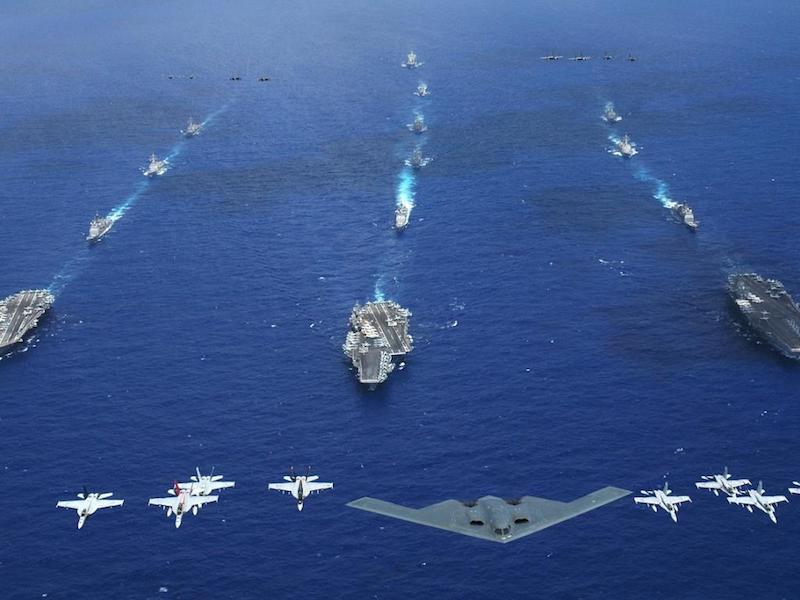
Recently, US Secretary of State Mike Pompeo had said Beijing’s claims to offshore resources across most of the South China Sea are completely 'unlawful'.
"The United States champions a free and open Indo-Pacific. Today we are strengthening U.S. policy in a vital, contentious part of that region — the South China Sea," Pompeo said in a statement.
"We are making clear: Beijing’s claims to offshore resources across most of the South China Sea are completely unlawful, as is its campaign of bullying to control them," he said.
"In the South China Sea, we seek to preserve peace and stability, uphold freedom of the seas in a manner consistent with international law, maintain the unimpeded flow of commerce, and oppose any attempt to use coercion or force to settle disputes," Pompeo said.
So far, the US had opposed China's actions but not called them illegal until this time.
Speaking further on the issue, Pompeo said: "Beijing uses intimidation to undermine the sovereign rights of Southeast Asian coastal states in the South China Sea, bully them out of offshore resources, assert unilateral dominion, and replace international law with 'might makes right.' Beijing’s approach has been clear for years."
"The PRC has no legal grounds to unilaterally impose its will on the region. Beijing has offered no coherent legal basis for its “Nine-Dashed Line” claim in the South China Sea since formally announcing it in 2009," he said.
Meanwhile, it is unclear how things will play out after Pompeo's comments and what is going to be the US follow-up action amid worsening of relations between China and a number of countries like Brunei, Malaysia, the Philippines, Taiwan and Vietnam contesting China's claim to almost all of the South China Sea.
The South China Sea Dispute:
The South China Sea dispute, according to Council on Foreign Relations (CFR), originates from China’s sweeping claims of sovereignty over the sea and its estimated 11 billion barrels of untapped oil and 190 trillion cubic feet of natural gas. Competing claimants Brunei, Indonesia, Malaysia, the Philippines, Taiwan, and Vietnam are riled by China's high-handedness.
The South China Sea disputes involve both island and maritime claims among these sovereign states.
An estimated US$3.37 trillion worth of global trade passes through the South China Sea annually, which accounts for a third of the global maritime trade
According to CFR, in recent years, satellite imagery has shown China’s increased efforts to reclaim land in the South China Sea by physically increasing the size of islands or creating new islands altogether.
In addition to piling sand onto existing reefs, China has constructed ports, military installations, and airstrips—particularly in the Paracel and Spratly Islands, where it has twenty and seven outposts, respectively. China has militarized Woody Island by deploying fighter jets, cruise missiles, and a radar system, said the CFR website quoting various sources.
Support Our Journalism
We cannot do without you.. your contribution supports unbiased journalism
IBNS is not driven by any ism- not wokeism, not racism, not skewed secularism, not hyper right-wing or left liberal ideals, nor by any hardline religious beliefs or hyper nationalism. We want to serve you good old objective news, as they are. We do not judge or preach. We let people decide for themselves. We only try to present factual and well-sourced news.
Support objective journalism for a small contribution.