


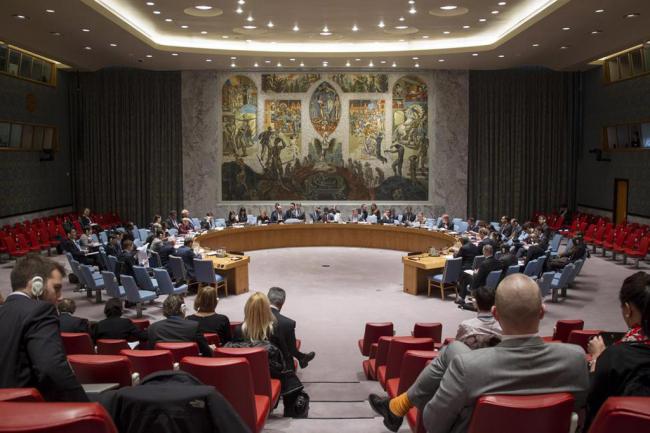
Security Council demands Houthi militias 'immediately' withdraw from capital, begin political process
Unanimously adopting a new resolution in a rare Sunday evening session, the Security Council expressed alarm at the acts of violence committed by the Houthis and their supporters, which have undermined the political transition process in Yemen, and jeopardized the country's stability and unity, demanding that all Yemeni “parties cease all armed hostilities against the people and the legitimate authorities of Yemen.”
The Council's action comes just days after Secretary-General Ban Ki-moon warned in aspecial briefing to the 15-member body that: “Yemen is collapsing before our eyes. We cannot stand by and watch.” Ban reminded the international community of its “solemn obligation” under the UN Charter to “do everything possible to help Yemen step back from the brink and get the political process back on track.”
Acting on a Jordan and United Kingdom-led text, the Security Council “deplored the unilateral actions taken by the Houthis to dissolve parliament and take over Yemen's Government institutions,” and reiterated its call for all Yemeni parties to adhere to resolving differences through dialogue and consultation, reject acts of violence to achieve political goals, and refrain from provocation to undermine the political transition.
The Council further demanded that Houthis withdraw their forces from Government institutions, including in the capital, Sana'a, and normalize the security situation in the capital and other provinces, as well as safely release President Hadi, Prime Minister Bahah, members of the Cabinet and all individuals under house arrest or arbitrarily detained.
Supporting the efforts of the Gulf Cooperation Council (GCC) in assisting the political transition in Yemen, the Security Council urged all parties to agree upon and announce publicly dates for completing the constitutional consultation process, to hold a referendum on the constitution, and to conduct elections under the new electoral law pursuant to the new constitution.
Despite the formation of a new Government in November 2014 aimed at ending a period of political turbulence and bringing about a full transition towards democracy, Yemen continues to be plagued by violence and mass political demonstrations.
In recent weeks, the Secretary-General has voiced serious concern about developments following the abduction by the opposition group Ansarallah of President Abd-Rabbu Mansour Hadi's chief of staff and the resignation of the President and Prime Minister amid a takeover of the capital, Sana'a by Houthi militants. This followed a steady deterioration since the beginning of the year as Government forces clashed with militant groups throughout the capital.
In his briefing to the Council last week, the UN chief also warned that “widespread and lethal” attacks by Al-Qaeda in the Arabian Peninsula (AQAP) and escalating hostilities between AQAP and the Houthis have pushed the country to the edge of civil war. These developments, coupled with a burgeoning humanitarian crisis which has enveloped an “astounding” 61 per cent of the population, now threaten regional and international peace and security, Ban added.
UN Special Adviser Benomar, who has continued to facilitate negotiations with all national stakeholders despite very difficult operational circumstances, also at that briefing, cautioned the Council that Yemen stood at a “crossroads.”
“Either the country will descend into civil war and disintegration, or the country will find a way to put the transition back on track,” he declared. “This largely depends on the political will of Yemeni leaders. They all bear responsibility for the current state of affairs, as well as responsibility for finding a way to pull the country from the brink.
UN Photo/Loey Felipe (file)
Support Our Journalism
We cannot do without you.. your contribution supports unbiased journalism
IBNS is not driven by any ism- not wokeism, not racism, not skewed secularism, not hyper right-wing or left liberal ideals, nor by any hardline religious beliefs or hyper nationalism. We want to serve you good old objective news, as they are. We do not judge or preach. We let people decide for themselves. We only try to present factual and well-sourced news.
Support objective journalism for a small contribution.


