


 Horn Of Africa
Relief chief underlines need for urgent support as millions face drought in Horn of Africa
New York: Humanitarians continue to call for scaling up assistance in the Horn of Africa, where the worst drought in 40 years is affecting some 15 million people across Kenya, Ethiopia, and Somalia.
The drought follows four consecutive failed rainy seasons, and the fear is the number could jump to 20 million if the current below-average rains fail.
UN Humanitarian Coordinator Martin Griffiths was in the region this week on a two-day mission to Kenya to raise awareness of this climate-induced emergency, which is happening at a time when global attention is focused on numerous crises.
Last month, he released $12 million from the UN’s Central Emergency Response Fund (CERF) to respond to the drought, while another $17 million was allocated from the Ethiopia Humanitarian Fund.
Families in misery
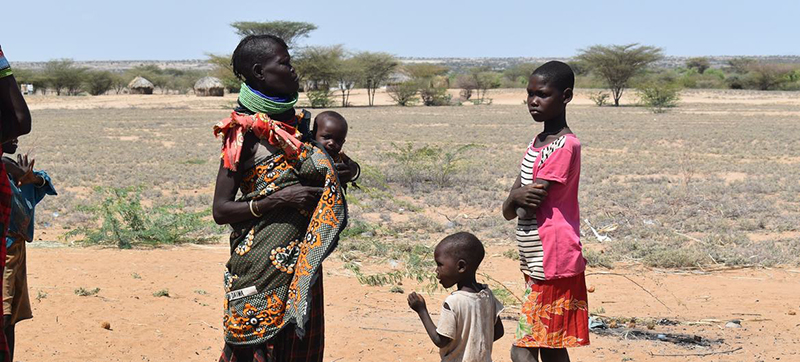
The relief chief was in remote Turkana county, northern Kenya, on Thursday to show solidarity with local communities and underline the need for more funding and food aid.
The UN and partners require $480 million to support the humanitarian response through October.
“The world’s attention is elsewhere, and we know that,” he said. “And the world’s misery has not left Turkana. And the world’s rains have not come to Turkana.”
Mr. Griffiths spoke to families in Lomoputh who have nothing left. Their animals have died and there is no way to make money.
‘Impossible choices’
Although children can sometimes get food at school - often the only thing to eat available - this requires walking six kilometres to fetch water for the children to take with them.
As a result, mothers are being forced to make “impossible choices”, he said.
“One of them said to us that some of them even have children who are of the age to go to secondary school… but to pay the fees to go to a secondary school in this area, you need to sell livestock. Sell a goat, as she said. There’s no more goats. There’s no more livestock. They’ve gone.”
Malnutrition and migration
Some 3.5 million people in Kenya are severely food insecure and acute malnutrition rates in some areas are more than double the emergency threshold, according to the UN humanitarian affairs office, OCHA, which Mr. Griffiths heads.
Across the three countries, roughly 5.7 million children are acutely malnourished,
Additionally, more than three million livestock—which pastoralist families rely on for sustenance and survival —have died.
Mr. Griffiths concluded his mission to Kenya on Friday, meeting virtually with people in Ethiopia’s Somali region.
The severe drought is affecting more than eight million people across the country. More than 7.2 million need food aid, and some four million require water assistance.
At least 286,000 people have migrated in search of water, pasture, or assistance, but others, often the elderly or the sick, have remained behind.
In a post on Twitter, Mr. Griffiths urged the international community not to ignore the rapidly escalating crisis in the Horn of Africa.
"We need urgent action to help these communities survive now, and increased investment in their ability to withstand future shocks," he wrote. "We need to give them a future."
Support Our Journalism
We cannot do without you.. your contribution supports unbiased journalism
IBNS is not driven by any ism- not wokeism, not racism, not skewed secularism, not hyper right-wing or left liberal ideals, nor by any hardline religious beliefs or hyper nationalism. We want to serve you good old objective news, as they are. We do not judge or preach. We let people decide for themselves. We only try to present factual and well-sourced news.
Support objective journalism for a small contribution.


