


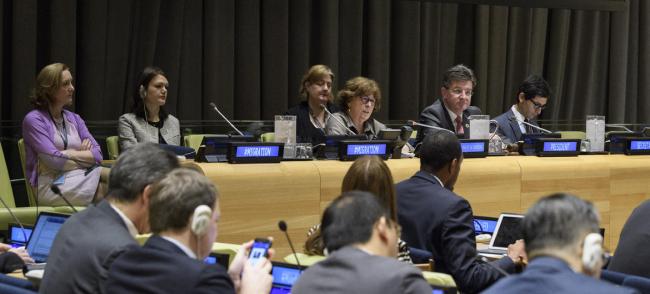
Realistic solutions must form basis of Global Compact for migration – UN conference
New York, May 22 (IBNS): Reflecting the reality of life on the ground for millions of migrants fleeing their homes must form the basis of the upcoming United Nations-backed Global Compact for migration, a hearing on the key issue was told on Monday.
The preparatory conference at UN Headquarters in New York, was the fifth and final hearing on the compact; with a focus on existing practices for safe, orderly and regular migration. The General Assembly is due to hold an intergovernmental conference with a view to adopting it later this year.
At Monday’s session, entitled Migration – What’s Really Going On: Lessons from the field, Miroslav LajÄák, President of the General Assembly, recalled the impact of past discussions which had focused around topics such as such as people smuggling and trafficking; national and regional perspectives, and misinformation over migration.
“They have allowed us to take a break from the politics – and focus, instead, on the realities,” he said. “Migration affects all of society – so all of society is needed, to respond,” he stressed.
While indicating that the needs and rights of migrants must be balanced with those of States and communities, he pointed out that migration is nothing new.
“We have centuries of policies and practices...trials and errors...successes and failures to learn from,” he said.
He spoke of the need for policies that enabled development, safeguarded human rights and ensured security, inviting all present to share ideas, solutions, experiences and opinions.
“You are the reality checks; the sounding boards; the sources of information, as we head into the final stages of negotiation,” he concluded.
Speaking next, Louise Arbour, Secretary-General of the Intergovernmental Conference on International Migration, painted a picture of migration as “highly time-bound and context specific,” saying that the Global Compact should allow for “sufficient flexibility to calibrate policies to continuously evolving context and reality.”
She flagged that many migrant workers face discrimination and exploitative working conditions, despite most empirical evidence suggesting that immigrants do not depress wages and living standards of native workers.
“Tailor made in-context specific solutions are required,” she stressed. Adding, “The Compact should provide a compendium of desirable initiatives, anchored in human rights in response to the interest and the circumstances of all concerned.”
In his remarks, William Lacy Swing, Director General of the International Organization for Migration (IOM), highlighted the importance of successful stakeholder partnerships.
He said the Global Forum on Migration and Development, offered a clear structure for policy-makers, practitioners, migrant organizations and the private sector, among others.
He credited city mayors with developing tailor-made solutions to respond to migrants’ needs, saying “Local authorities are often the place where migrants can have their demands heard.”
Finally, he explained how private sector partnerships have solidified many migrants’ place in local labour markets.
“The sovereignty of States and multi-stakeholder engagement are not inconsistent and should not be seen as mutually exclusive,” he said. “In fact, multi-stakeholder partnerships can strengthen State sovereignty,” he added.
Support Our Journalism
We cannot do without you.. your contribution supports unbiased journalism
IBNS is not driven by any ism- not wokeism, not racism, not skewed secularism, not hyper right-wing or left liberal ideals, nor by any hardline religious beliefs or hyper nationalism. We want to serve you good old objective news, as they are. We do not judge or preach. We let people decide for themselves. We only try to present factual and well-sourced news.
Support objective journalism for a small contribution.


