


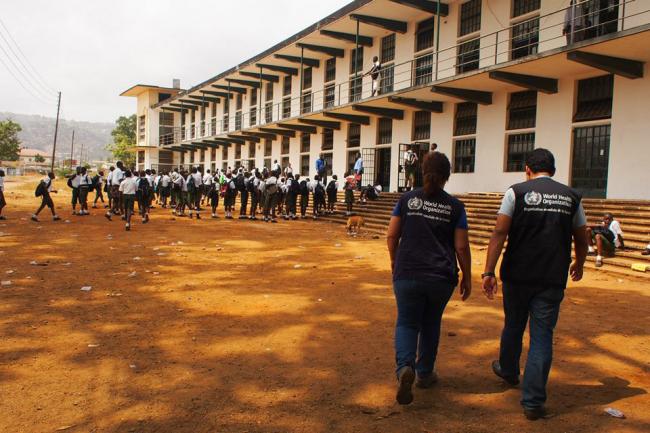
Progress in fighting Ebola must be followed by long-term recovery efforts
“The goal is to help people and their communities to return to a normal life again,” said Margaret Chan, Director-General of the World Health Organization (WHO).
She said, “It means that children are going back to school, women can once again shop in their local markets, and livelihoods are restored.”
She placed particular importance on rebuilding health systems and services to reduce risks that were inherent within weak systems. Such rebuilt systems should cover basic, essential, primary healthcare with sensitive surveillance to give early warnings of any dangerous outbreaks.
“The health systems in the three countries were fragile to begin with,” Dr. Chan acknowledged.
She added, “They collapsed during the Ebola outbreak.”
She said trust and confidence must be restored to ensure that parents immunize their children, pregnant women have confidence in giving birth safely and so malaria and other infectious diseases can be prevented.
Bruce Aylward, Assistant Director-General of the WHO provided some impressions of the outbreak response from the front-lines. He underlined the importance of building resilient systems and helping the most-affected States – Guinea, Liberia and Sierra Leone – to recover.
Yet, he stressed that it would be impossible to fully recover if the main task – eradicating Ebola – was not completed.
He said, “Success is not assured. There is a terrible, terrible and growing sense that this is done. This is not done. It started with one case. There were 37 cases last week. It is not done.”
While pointing to “stunning” progress in reining in the outbreak and meeting ambitious targets on reducing prevalence of Ebola, including the effort to limit new cases to coastal areas that would be easier to control as the rainy season looms, Dr. Aylward stressed the difficulty associated with those efforts.
“It’s been 12 grinding months to get here but that’s where we’ve arrived right now,” he said. “It’s a bumpy road but it is going in the right direction.”
David Nabarro, the UN’s Special Envoy on Ebola, stressed how tough the global response to the “frightening devastation” wrought by Ebola has been throughout the process so far.
“It’s a cause of insecurity that needs to be taken as seriously as terrorism,” he said. “It needs defences as well financed and organised as terrorism.”
Photo: WHO/N. Alexander
Support Our Journalism
We cannot do without you.. your contribution supports unbiased journalism
IBNS is not driven by any ism- not wokeism, not racism, not skewed secularism, not hyper right-wing or left liberal ideals, nor by any hardline religious beliefs or hyper nationalism. We want to serve you good old objective news, as they are. We do not judge or preach. We let people decide for themselves. We only try to present factual and well-sourced news.
Support objective journalism for a small contribution.


