


Preventing and resolving conflicts must form ‘backbone’ of collective efforts – UN chief
New York, Dec 7 (IBNS): More countries are experiencing violent conflict now than at any time over the past 30 years, Secretary-General António Guterres told the Security Council on Thursday, underscoring that the world has a responsibility to act “collectively”.
“Low intensity conflicts have increased by 60 per cent in the last ten years,” Mr. Guterres told the Council, which was considering how nations and small international bodies below the regional level, can work better with the UN in preventing and resolving conflicts.
“Complex links” between threats cannot be seen in isolation, the UN chief remarked, citing conflicts, natural disasters, pandemics and possibly new technology.
“Preventing conflict is our collective responsibility,” he said, calling regional and sub-regional organizations “critical” to a multidimensional approach “commensurate with the scale of the challenge.”
Rather than manage crisis and conflict, “we should put far more effort into preventing them,” he asserted, and “invest in reducing the need for aid.”
He explained that prevention is also a political instrument that that saves lives, as well as making good sense economically. Pointing to the UN-World Bank study, Pathways for Peace, he maintained that prevention could save countries an estimated $34 billion.
One “strong sign of support” for the doctrine could be seen in the central role of peacekeepers, as endorsed by 151 Member States so far, in the form of the Action for Peacekeeping initiative.“These benefits are compounded over time to reach over $140 billion after 15 years,” he argued.
Moreover, the UN is tackling root causes of conflict, said the UN chief, including ethnic and religious divisions; inequality and exclusion; and the marginalization of women, young people and minority groups – that render communities vulnerable to violence. Mr. Guterres upheld that these are interlinked and exacerbated by climate change, migration, transnational crimes and global terrorism.
He also flagged the importance of partnering with sub-regional and regional organizations, noting the UN’s relationship with the African Union (AU) and Agenda 2063 to build a prosperous, united continent.
“From climate change to inequality, today’s challenges cannot be managed by any single State or organization,” emphasized the UN chief, urging world leaders to use the 2030 Agenda as a universal roadmap to recommit to multilateralism and embrace complementarity.
Underlining the need for “courage and political will,” the Secretary-General stated that early action, collaboration, prevention and resilience “must form the backbone of our collective efforts.”
Noting that latent tensions transform into open conflict, Moussa Faki Mahamat, Chairperson of the AU Commission, observed the obstacle that while sustained prevention was “of crucial importance,” African States often viewed early intervention as “a breach of their sovereignty.”
For his part, Jean-Claude Kassi Bro, Commission President of the sub-regional Economic Community of West African States (ECOWAS), said the UN and AU’s support was important for its work. He also reiterated the unwavering commitment of ECOWAS to consolidate and build peace for sustainable development.
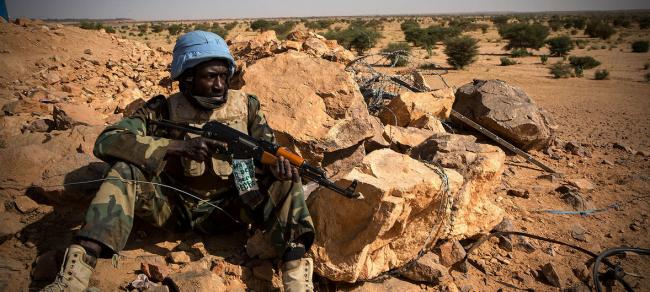
MINUSMA/Harandane Dicko
Support Our Journalism
We cannot do without you.. your contribution supports unbiased journalism
IBNS is not driven by any ism- not wokeism, not racism, not skewed secularism, not hyper right-wing or left liberal ideals, nor by any hardline religious beliefs or hyper nationalism. We want to serve you good old objective news, as they are. We do not judge or preach. We let people decide for themselves. We only try to present factual and well-sourced news.
Support objective journalism for a small contribution.


