Population growth in Occupied Palestinian Territory to drive demand for housing, services – UN
The report Palestine 2030 Demographic Change: Opportunities for Development, which notes that while it is clear that the decades-long occupation and dependence of foreign assistance have hampered growth, also demonstrates how population trends and dynamics play a powerful role in development and therefore must be factored into planning and policy decisions.
Speaking with UN Radio, Anders Thomsen, UNFPA Representative to the State of Palestine about the current trends and the anticipated impacts said: “If you had said twenty years ago, ten years ago, would Gaza be able to cope with a blockade, a very strict blockade for 10 years and three very harsh wars, would Gaza be able to cope with it – the fact is, Gaza is coping with it and the people in Palestine are remarkably strong and resourceful. But at some point, something will have to give.”
Fertility rates are twice the rate of those in the more advanced areas in the region – a trend that is expected to bring its population from the current 4.7 million to 6.9 by 2030 and to 9.5 million by 2050. The highest rate of growth is expected to occur in Gaza, where the report estimates a population of 1.85 million will reach 3.1 million by 2030 and 4.7 million by 2050.
In addition to a growing population, the number of women entering the labour force has also been steadily rising, with nearly one third of Palestinian women now working.
“How do we create the enabling environment to have enough economic growth to ensure that this growing population can have economic opportunities?” asked Thomsen.
In consideration of the demographic trends, the report estimates that the number of jobs that will need to be created per year will increase from an annual 58,000 to 72,000 by 2030. It urges that job creation take into account not only new workers, but also those who are unemployed and under-employed. In 2015, the rate of unemployment was 26 per cent.
The UN official said he believes that enough dialogue has been had and that the focus now needs to be on creating opportunities for people and goods to move freely and for trade to resume so that Gaza and the Occupied Palestinian Territory can be fully integrated into the international economy.
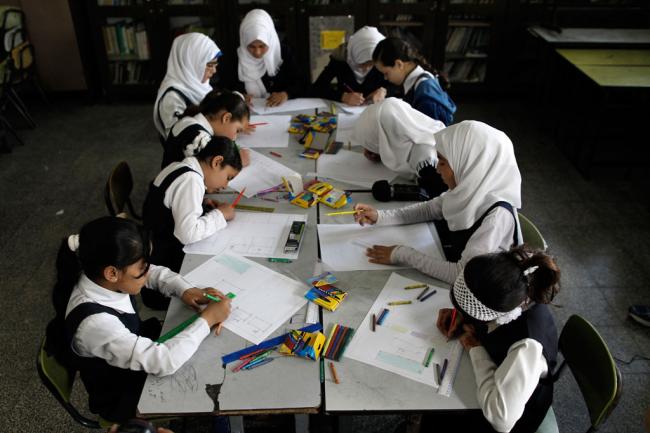
New and more strenuous demands are also expected to affect education, as there will be a 48 per cent increase in the number of people aged between four and 22 years old by 2050. Again, these demands will be seen most significantly in Gaza, where residents are already younger and fertility rates and other relevant indicators are expected to create a faster-growing population.
The report estimates that educational enrolment rates in Gaza will surpass those in the West Bank between 2025 and 2030.
“I hope it will be a wakeup call. If people are taking these numbers and figures and projections seriously, they will see a different way of thinking on Wednesday will be required to avoid a disastrous situation in 14 years,” said Thomsen.
Photo: UNICEF/Eyad El Baba
Source: www.justearthnews.com
Support Our Journalism
We cannot do without you.. your contribution supports unbiased journalism
IBNS is not driven by any ism- not wokeism, not racism, not skewed secularism, not hyper right-wing or left liberal ideals, nor by any hardline religious beliefs or hyper nationalism. We want to serve you good old objective news, as they are. We do not judge or preach. We let people decide for themselves. We only try to present factual and well-sourced news.
Support objective journalism for a small contribution.