


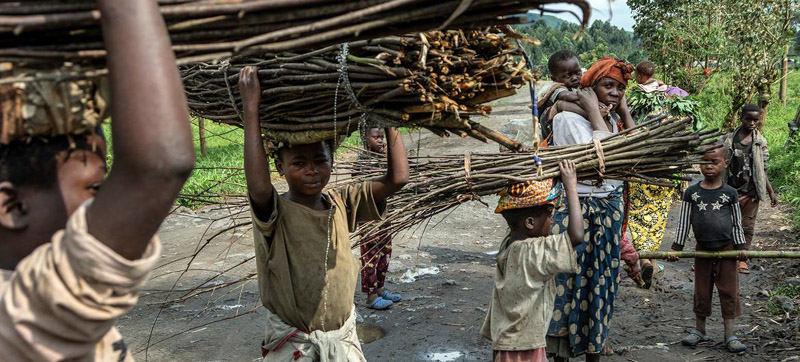
 Child Labour
One in every 10 children works - instead of going to school
New York: Around the world, some 160 million children work to earn a living, instead of going to school. That’s almost one in every 10 children.
On Monday’s World Day against Child Labour, the International Labour Organization (ILO) shared these staggering numbers as a reminder of the urgent need to end this practice.
ILO’s Director-General Gilbert Houngbo said that for the first time in 20 years, child labour is on the rise.
“Child labour rarely happens because parents are bad, or do not care. Rather, it springs from a lack of social justice,” he said.
Solutions: decent work, social protection
Mr. Houngbo stressed on Twitter that the “most effective solutions” to the child labour emergency are decent work for adults, so that they can provide for their families, and improved social protection.
He also underscored that tackling the root causes of child labour requires
ending forced labour, creating safe and healthy workplaces, letting workers organize and make their voices heard, as well as ending discrimination, since child labour often affects the most marginalized.
Staggering figure for sub-Saharan Africa
More than half of all those subjected to child labour – some 86.6 million – are in sub-Saharan Africa, according to joint research by the ILO and the UN Children’s Fund (UNICEF).
Almost 24 per cent of all children in the region, or close to one in four, are in child labour.
Bulk of child labour in agriculture
Most of those in child labour on the African continent, and indeed worldwide, work in agriculture. The UN’s Food and Agriculture Organization (FAO) said on Monday that agriculture accounts for 70 per cent of child labour globally and that the numbers of youngsters working in the sector are on the rise.
FAO stressed that child labour was three times more prevalent among rural smallholders in farming, fisheries or forestry than in urban areas.
The agency emphasized that children often assist their parents in producing crops, rearing livestock or catching fish, “mainly for family consumption”, and that while not all this work is considered child labour, “for too many children, their work, particularly in agriculture, goes beyond the limits of safety and well-being and crosses into a form of labour that can harm their health or educational opportunities”.
‘Ensure that children have a childhood’
FAO underscored the need to tackle the issue “from the field right up to the global level, to ensure that children have a childhood”.
The agency is working with partners on eliminating child labour in key sectors such as cocoa, cotton and coffee. Together with ILO and the European Union, FAO has reached more than 10,000 women, men, youth and children in Burkina Faso, Mali and Pakistan as part of a project aiming to address child labour in cotton value chains by improving households’ livelihoods, empowering women economically, and raising awareness of the problem.
FAO has also developed a framework on ending child labour in agriculture, aiming to provide guidance to policymakers, and has supported countries such as Uganda and Cabo Verde in developing prevention policies.
Support Our Journalism
We cannot do without you.. your contribution supports unbiased journalism
IBNS is not driven by any ism- not wokeism, not racism, not skewed secularism, not hyper right-wing or left liberal ideals, nor by any hardline religious beliefs or hyper nationalism. We want to serve you good old objective news, as they are. We do not judge or preach. We let people decide for themselves. We only try to present factual and well-sourced news.
Support objective journalism for a small contribution.


