No country has yet achieved equality between men and women: UN rights chief
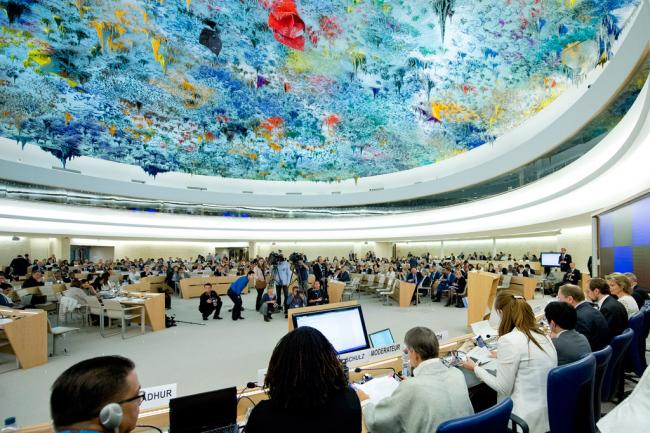
“Very frequently, we see a preponderance of women experts on panels that discuss issues specific to women and children – as if such issues could not be of deep concern to men,” Zeid Ra’ad Al Hussein said in his opening remarks to a panel discussion on gender equality held by the Council in Geneva.
“Conversely, discussions on situations of armed conflict, on counter-terrorism, on sanctions regimes, and on the death penalty almost seem as though they are reserved for men,” he noted.
The High Commissioner said “the lack of gender parity in UN human rights bodies may indeed be symptomatic of the under-representation of women in Member States,” adding that “we need to do better than our societies.”
He spoke of the importance of “visible equality.”
“Girls may stay away from computer technology or engineering because beating the boys in maths is seen as somehow ‘unfeminine,’” he noted, and “girls who grow up seeing only male presidents or ambassadors may develop a belief that power is essentially male.”
He said “quotas and other temporary efforts to achieve parity can help to bring women’s voices into legal and political systems, the corporate boardroom, the workplace and higher education,” leapfrogging a process that might otherwise take generations.
Saying “all of us have the power and responsibility to promote gender parity,” he urged action “to address discrimination, combat stereotypes, and promote equality” at the international and national levels.
“We must stop regarding parity as a token exercise, and grasp at last that equal representation of women and men, across themes and bodies, not only embodies but also builds more just societies,” he said.
For his part, the High Commissioner pledged that he will no longer take part in any panel discussion that does not include women experts, and committed to improving gender parity within his office.
At its 6th session, the Human Rights Council encouraged States to promote gender balance by taking all the necessary measures, including budgetary and institutional measures, to guarantee the full participation of women in medium- and high-level ranks, regularly nominating more women candidates for election and appointment to the human rights treaty bodies and mechanisms, international courts and tribunals, the specialized agencies and other UN organs.
Photo: UN Photo/Jean-Marc Ferré
Support Our Journalism
We cannot do without you.. your contribution supports unbiased journalism
IBNS is not driven by any ism- not wokeism, not racism, not skewed secularism, not hyper right-wing or left liberal ideals, nor by any hardline religious beliefs or hyper nationalism. We want to serve you good old objective news, as they are. We do not judge or preach. We let people decide for themselves. We only try to present factual and well-sourced news.
Support objective journalism for a small contribution.