Nine killed in direct hit on UNRWA shelter in Gaza amid ongoing conflict with Israel
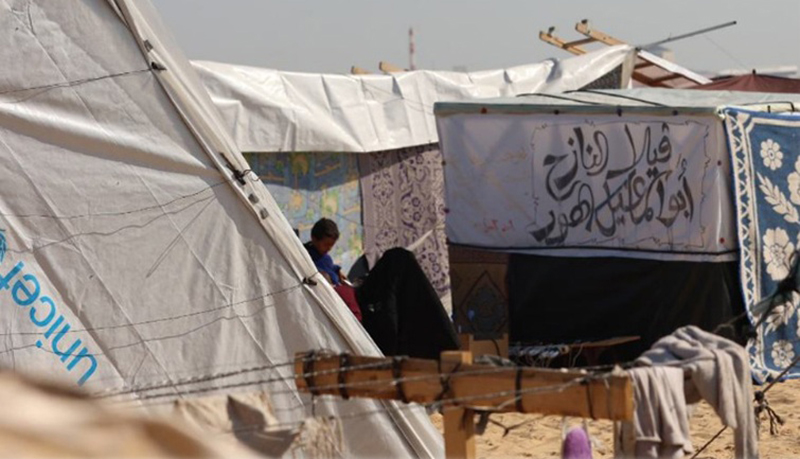
Nine people were killed and 75 injured on Wednesday in a direct hit on a training centre turned shelter in southern Gaza run by UNRWA, the UN agency that assists Palestinians, according to initial reports.
Teams from the agency and the World Health Organization (WHO) were trying to reach the Khan Younis Training Centre, said Tom White, Director of UNRWA Affairs in the Gaza Strip, in post on the social media platform X.
Some 30,000 people are sheltering at the site and the death toll could be higher, said Philippe Lazzarini, UNRWA Commissioner General, who also took to the platform to lament "another horrific day in Gaza".
"The compound is a clearly marked 'UN facility' and its coordinates were shared with Israeli authorities, as we do for all our facilities," he said, adding "once again a blatant disregard of basic rules of war".
Shock and resignation
The incident was indicative of the recent intense fighting around Khan Younis, said Jamie McGoldrick, interim UN Humanitarian Coordinator for the Occupied Palestinian Territory, speaking during a press briefing from Jerusalem.
McGoldrick updated journalists on his visit to Gaza on Tuesday, where he said humanitarians are struggling to provide displaced people with basic services such as food, medical support, shelter, water and sanitation.
“As a result of that, the people themselves are really struggling to get through this, and the shock is actually starting to wane now, and people start to see…a resignation that this is what we're going to have to face for some significant time.”
While in Gaza, McGoldrick visited the southern city of Rafah, located on the border with Egypt, and a crossing point for aid into the enclave.
Rafah normally has a population of around 280,000, which has swelled to an estimated 1.2 to 1.4 million as people fleeing fighting elsewhere pack into the city, setting up makeshift shelters and tents in the streets.
The squalid and unsanitary conditions have led to outbreaks of respiratory infections and hepatitis A, both of which had been eradicated in Gaza. Meningitis and other illnesses are also emerging.
Shelter and safety
The conflict in Gaza has displaced over 75 per cent of the population, with nearly 1.7 million people now living in UNRWA and public emergency shelters as well as informal sites.
He said humanitarians are facing “massive issues” trying to provide shelter for displaced people seeking safety in the south. Some have moved from Rafah to the coastal town of Al-Mawasi, which is poorly supported or serviced by aid agencies, given the overwhelming numbers in need.
Currently, around 250 trucks come through the Rafah border “on a good day” when in the past, roughly 500 trucks from the private sector would bring in basic commodities daily.
More supplies needed
McGoldrick said the UN and partners are doing their best in the face of massive challenges, many of which are outside their control, and he emphasized the need for “minimum operating requirements” so they can work better.
“We need more supplies to come in from the private sector. We need to be able to scale up our pipelines and the key lifesaving commodities, but also from the authorities, the Israeli side, we need to get them to give us communications equipment,” he said.
Humanitarian workers are being sent into very hostile areas, “and they have no radios, they have no communications that work for them to be able to be seen to be safe,” he said, adding that they also do not have enough armoured vehicles.
Critical items ‘prohibited’
Furthermore, many of the goods humanitarians are trying to bring into Gaza to support water and sanitation “seem to be prohibited by the Israelis”, he said.
“They see them as something that could be used for other things such as pumps, such as generators, such as spare parts, pipes for water sanitation, solar panels and some medical equipment, which is key to our ability to address the humanitarian crisis that's there in front of us,” he said.
Some of the medical materials include basic drugs for treating chronic illnesses such as insulin pens for children.
Humanitarians are also facing difficulties with bringing in enough shelter material, including tarpaulins, blankets and non-food items.
Fuel for hospitals
McGoldrick said more fuel also needs to get to the north to supply generators inside hospitals there, such as Al-Shifa, “because they're working in some cases without anaesthetic, without electricity, to serve patients who are also ill and been wounded”.
He added that there is no real medical or casualty evacuation system in place to transport badly wounded people out of Gaza.
“We're not able to get people out farther afield to the neighbouring countries in order to get this very sophisticated surgery, and that's something we've been trying to work with the Israelis on,” he said.
Support Our Journalism
We cannot do without you.. your contribution supports unbiased journalism
IBNS is not driven by any ism- not wokeism, not racism, not skewed secularism, not hyper right-wing or left liberal ideals, nor by any hardline religious beliefs or hyper nationalism. We want to serve you good old objective news, as they are. We do not judge or preach. We let people decide for themselves. We only try to present factual and well-sourced news.
Support objective journalism for a small contribution.