New UN report urges action to end 'unimaginable suffering' for separated families on Korean peninsula
“The emotional, psychological, social, and economic toll of involuntary separation persists to this day, as people continue to search for the truth and for contact with their loved ones,” said UN High Commissioner for Human Rights Zeid Ra'ad Al Hussein.
The report, published on Wednesday by the UN Human Rights Office of the High Commissioner (OHCHR), documents the experiences of families who have been separated since the 1950-1953 Korean War through displacement, forced disappearance and abductions, and as a result of those fleeing the Democratic People's Republic of Korea (DPRK).
This report looks at past and present-day forms of involuntary separation and outlines a practical and humane approach to family reunification. These people are not just statistics; they are not a faceless mass of victims caught up in the sweep of history. They are individuals with their own, unimaginable, stories of suffering – a suffering that remains as acute as ever despite the passing of years,” the High Commissioner explained.
Through interviews and research, the report finds that involuntary separation has not only been through the inevitable consequences of war, but also due to structural forms of exclusion and impunity. Women, in particular, have suffered long-lasting prejudice.
For example, Park Dong-yeol [name changed], now 85, fled North Korea in 1950. She was denied access to a boat leaving for the Republic of Korea due to a superstition about having women aboard. When she finally reached South Korea via foot, she was kept under close surveillance. Authorities were suspicious of a single woman, prompting her to marry once she “lost hope” of being reunited with her family who had remained in the DPRK.
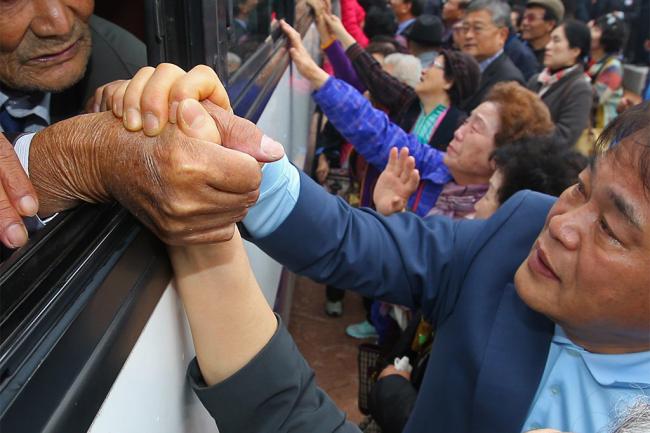
While occasional but tightly controlled reunions for some 100 families on both sides of the peninsula began in 2000, such meetings often bring about more stress than reconciliation, sayd the report.
In 2015, Ji Eungyeong [name changed] met with her daughter who she left behind in North Korea 64 years ago.
“We could barely talk in the hall,” she shared. “There were journalists on one side and [guards] on the other. Then we had two hours of private time. Only then was my daughter able to cry.”
The report also shares the experiences of people in Republic of Korea whose family members were abducted. In 1950, Jeong Sun-ui's father disappeared, leading the rest of the family to be treated with suspicion, fearing that they might be spies.
“There was always a sense of guilt by association,” he said.
Since 2008, due to more stringent border controls, the number of people who have escaped from DPRK to ROK has decreased. Those who do risk their lives – frequently women – are exposed to brutal treatment including labour sentences if caught. If they escape, their families are at risk for acts of retaliation and harassment by the authorities.
The report calls for unhindered contact for people in both countries, public and complete lists of all individuals who have been missing since the war and determining their whereabouts, and protecting those who leave DPRK.
OHCHR acknowledges that increases in political and military tensions in the region have generated extremely difficult obstacles, but nonetheless advocates action from DPRK in order to locate and return those who have been abducted, as well as removing restrictions that prevent citizens from travelling and communicating with the outside world.
Photo: OHCHR
Source: www.justearthnews.com
Support Our Journalism
We cannot do without you.. your contribution supports unbiased journalism
IBNS is not driven by any ism- not wokeism, not racism, not skewed secularism, not hyper right-wing or left liberal ideals, nor by any hardline religious beliefs or hyper nationalism. We want to serve you good old objective news, as they are. We do not judge or preach. We let people decide for themselves. We only try to present factual and well-sourced news.
Support objective journalism for a small contribution.