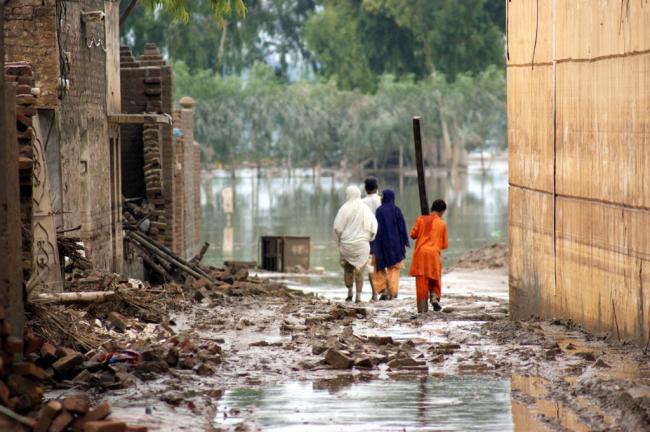
Natural disasters in Asia and Pacific affects 80 million people
That’s according to Natural Disasters in Asia and the Pacific: 2014 Year in Review report released on Wednesday by the UN Economic and Social Commission for Asia and the Pacific (ESCAP).
The report said that more than half of the world’s 226 natural disasters occurred in the Asia and Pacific region last year.
And although it was a year without a single large-scale catastrophe caused by an earthquake or tsunami, the region experienced severe storms, cross-border floods and landslides, which accounted for 85 percent of all disasters, it said.
In addition, more than 6,000 fatalities were caused by natural disasters, compared to 18,744 deaths in 2013, and an estimated 79.6 million people were affected by natural disasters across the Asia and Pacific, according to the report.
Economic losses owing to natural disasters in 2014 also remained high, amounting to some $59.6 billion, highlighting the lack of economic resilience in the region, said the report, which presented a diagnostic analysis of the region’s state of resilience and lessons learnt.
The report noted that the highest economic losses in Asia and the Pacific were incurred from river-basin floods ($16 billion) and Cyclone HudHud ($11 billion) in India, followed by the Ludian earthquake in China ($6 billion), and the tropical cyclones Lingling and Kajiki in Japan ($5.2 billion).
The region was found largely unprepared in its response to cross-border floods and landslides, according to the report.
“Such disasters, which may very well be on the rise because of climate change, require improved regional information exchanges and the joint coordination of operations for effective early warning and evacuations,” it said.
It also said, “The report calls for strengthened regional cooperation to address cross-border disasters.”
ESCAP noted that its findings show how preparedness for severe storm events through effective early warning systems has significantly reduced death tolls.
“One important lesson from 2014 is that end-to-end early warning systems save lives,” Shamika Sirimanne, Director of ESCAP’s Disaster Risk Reduction Division, was quoted as saying.
ESCAP said that leaders and decision-makers across Asia and the Pacific are preparing to finalize a new global framework for disaster risk reduction, which will succeed the 2005 Hyogo Framework for Action, at aconference to be held next month in Sendai, Japan, expected to attract around 8,000 participants.
“The lessons from 2014 clearly show that building resilience remains a key priority in protecting lives and assets in the Asia and the Pacific,” it said.
The Hyogo Framework for Action (HFA) is the first plan to explain, describe and detail the work that is required from all different sectors and actors to reduce disaster losses.
Photo: UN Photo/WFP/Amjad Jamal
Support Our Journalism
We cannot do without you.. your contribution supports unbiased journalism
IBNS is not driven by any ism- not wokeism, not racism, not skewed secularism, not hyper right-wing or left liberal ideals, nor by any hardline religious beliefs or hyper nationalism. We want to serve you good old objective news, as they are. We do not judge or preach. We let people decide for themselves. We only try to present factual and well-sourced news.
Support objective journalism for a small contribution.