


Minorities face discrimination at every turn in criminal justice systems: UN expert
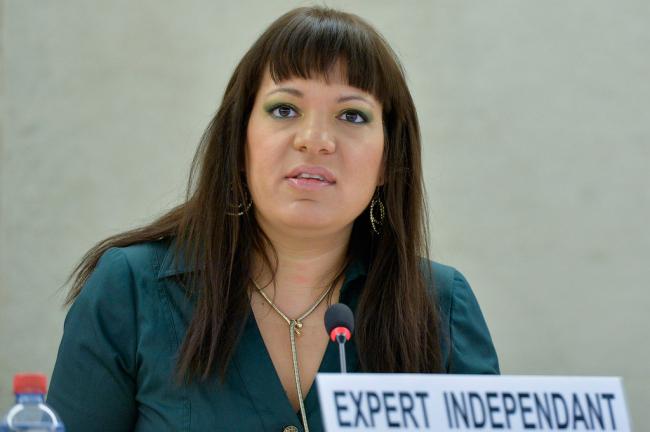
“The disproportionate targeting by law enforcement officers of individuals for identity checks, stop and search or other forms of coercive or privacy invasive police powers which are related purely to identity-based minority group characteristics, continues to take place around the world,” said Rita Izsák, the UN Special Rapporteur on minority issues.
Presenting her fourth report to UN General Assembly’s Third Committee – the Organization’s main body dealing with social, humanitarian and cultural issues, Izsák assessed the situation of the human rights of persons belonging to national or ethnic, religious and linguistic minorities in the various stages of the criminal justice process, from before arrest through to sentencing.
“The Special Rapporteur is alarmed by the many allegations that she has received of human rights violations committed against minorities in the administration of criminal justice, owing to their minority status,” the report said.
“[She] strongly condemned the practice of racial profiling,” according to the Office of the UN High Commissioner for Human Rights in a press release of the report.
The report highlights the following areas of concern for minorities in the administration of criminal justice, including: excessive and sometimes lethal use of force, torture or other ill treatment by police, including in detention; the overrepresentation of minorities in pre-trial detention, and longer periods of stay in pre-trial detention; discrimination against minorities during judicial procedures; and biases influencing not only on the outcome of a criminal trial itself, but also on sentencing for accused minorities.
“Although remedying the discrimination that minorities face in criminal justice system is not an easy task,” the expert said, “it is paramount that States address the underrepresentation of minorities in law enforcement agencies, including judiciaries, prosecution services and legal professions.”
Saying that measures to eliminate discrimination and ensure equality before the law are more likely to be effective if undertaken with a minority rights-based approach, the report outlined a series of recommendations to address discrimination in the administration of justice.
Izsák was appointed as Independent Expert on minority issues by the Human Rights Council in June 2011 and subsequently her mandate was renewed as Special Rapporteur on minority issues in March 2014. She works on a voluntary basis, is not UN staff and does not receive a salary for her work.
UN Photo/Jean-Marc Ferré
Support Our Journalism
We cannot do without you.. your contribution supports unbiased journalism
IBNS is not driven by any ism- not wokeism, not racism, not skewed secularism, not hyper right-wing or left liberal ideals, nor by any hardline religious beliefs or hyper nationalism. We want to serve you good old objective news, as they are. We do not judge or preach. We let people decide for themselves. We only try to present factual and well-sourced news.
Support objective journalism for a small contribution.


