Marginalized voices must be ‘included and amplified’ in digital technology space: UN Chief
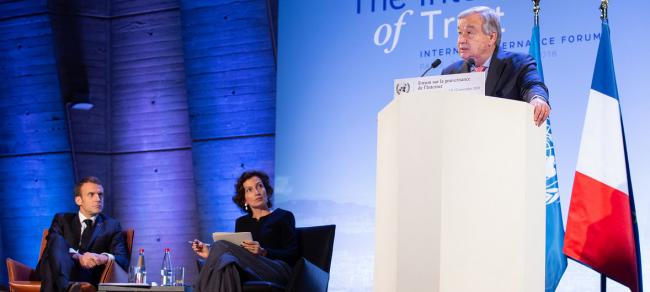
New York, Nov 13 (IBNS): New thinking is needed to better address deep gender gaps in access to digital technologies, seek out networks of the increasingly active elderly population, and support young people facing a rapidly transforming labour market, UN Secretary-General António Guterres told delegates on Monday, at the 2018 Internet Governance Forum (IGF), hosted in Paris by the UN Education, Scientific and Cultural Organization (UNESCO).
Guterres told the assembled delegates that he wants the Panel, and the IGF, to inspire new language on digital cooperation, weaving stories into a global narrative, and to included and amplify the weak and the missing voices: “I urge your digital discussions to move beyond the so-called ‘usual suspects’. Digital growth affects everyone, and traditionally unheard and marginalized voices should be more visibly involved in the IGF’s work. Get stories from people with disabilities, who are among the most creative users of digital technology.”
Discussions surrounding digital technology and society are still too siloed, he added, and should be widened to include more disciplines: “When you discuss data and artificial intelligence, you might want to invite philosophers to consider ethics. You might want to bring in anthropologists and other specialists who are not typically included in technology gatherings. When you discuss social media, you need to include political and social scientists.”Today, more than half the world’s population does not have meaningful access to the internet, and Guterres called for the IGF to reach out to governments, especially in developing countries, and listen to their ideas for making the Forum more productive for their needs.
The Secretary-General insisted that the discussion on internet governance must involve a wide range of expertise, and to lead to policy that is developed in a multilateral spirit in cooperation with governments, private sector, research centres and civil society, concluding that “When it comes to governance, we must be as creative and bold as those who first built the Internet.”
Referencing the UN High-Level Panel on Digital Cooperation, which he launched in July, Guterres noted that – at a time when cooperation amongst actors in the digital space has not kept pace with new technologies – the Panel is working closely with the IGF to improve digital cooperation.
Guterres’s comments were made during his keynote speech on the first day of the Forum, which runs from 12 to 14 November: he was joined on stage by French President Emmanuel Macron and Audrey Azouley, Director-General of UNESCO.
The IGF, convened annually by the Secretary-General and supported by UN Department of Economic and Social Affairs (DESA), brings together over 3,000 participants, including high-level government officials, civil society leaders, private sector and internet policy experts, to discuss international cooperation around issues such as fake news, the spread of disinformation, cybersecurity and privacy, big data, the Internet of Things, and their effects on society.
UNESCO/Christelle Alix
Support Our Journalism
We cannot do without you.. your contribution supports unbiased journalism
IBNS is not driven by any ism- not wokeism, not racism, not skewed secularism, not hyper right-wing or left liberal ideals, nor by any hardline religious beliefs or hyper nationalism. We want to serve you good old objective news, as they are. We do not judge or preach. We let people decide for themselves. We only try to present factual and well-sourced news.
Support objective journalism for a small contribution.