Mali parties must seize opportunity to resolve crisis: UN peacekeeping chief
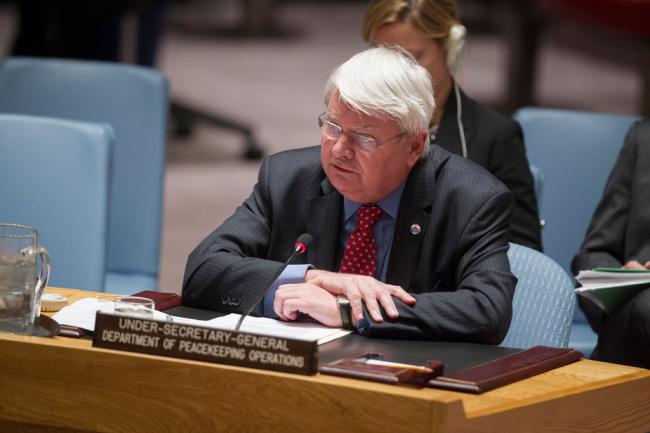
“The crisis in Mali can only be resolved through an inclusive and viable political agreement that can be implemented,” Hervé Ladsous said at a briefing to the Council during which the Foreign Minister of Mali, Abdoulaye Diop, also spoke.
Ladsous said there is a historical opportunity currently present in Mali as the international community has shown willingness to accompanying the parties in reaching and implementing a peace agreement.
“Extremism and criminality thrive in the lack of law and order,” he said, stressing that it was critical that all parties distance themselves from violent, illicit activities.
The Security Council must also emphasize that point, and he also pointed out that, since the last Council meeting on Mali, three more peacekeepers had lost their lives.
Introducing the Secretary-General’s 27 March report on Mali, he said that two of the three Malian parties – the Government and the so-called ‘Platform’ of northern movements – had initialled the text of a draft peace agreement on 1 March, following the fifth round of inter-Malian dialogue in Algiers.
The other coalition of northern movements known as the ‘Coordination,’ however, requested more time to consult with their constituency, he said. Talks continued between the Coordination and the international mediators, and the coalition had indicated it, too, would sign on next week on the understanding that further talks to clarify modalities of the agreement would follow. That was not certain at this point however, he cautioned.
As progress towards a negotiated solution advanced, it is critical that the Malian parties, supported by the mediators, begin putting in place a detailed framework and calendar of implementation, he said. Clear and robust implementation mechanisms would build confidence.
However, the security situation continues to remain a challenge. On 19 February, parties recommitted themselves to the ceasefire that is so far holding. Ladsous warned against any party seeking to gain ground militarily, emphasizing that peace is only possible through negotiations.
Speaking on deployment of the UN Multidimensional Integrated Stabilization Mission in Mali (MINUSMA), he said efforts are ongoing to scale up operations in the northern regions.
The military component has now reached 80 per cent of authorized deployment and that figure should rise significantly in the weeks to come. At the same time, infrastructure is being built, though hampered by security challenges.
Moreover, outreach to local populations is an important component of the Mission’s work, Ladsous said, reiterated that to continue these efforts, budgetary support is needed.
Photo: UN Photo/Loey Felipe
Support Our Journalism
We cannot do without you.. your contribution supports unbiased journalism
IBNS is not driven by any ism- not wokeism, not racism, not skewed secularism, not hyper right-wing or left liberal ideals, nor by any hardline religious beliefs or hyper nationalism. We want to serve you good old objective news, as they are. We do not judge or preach. We let people decide for themselves. We only try to present factual and well-sourced news.
Support objective journalism for a small contribution.