


In storm-hit Haiti, ‘physical rehabilitation and psycho-social support go hand-in-hand’ – UNESCO
“We have five main priorities,” the Head of UNESCO’s Haiti Office, Paul Gomis, said yesterday in a news release, emphasizing rehabilitation of schools from roofs to desks and furniture; kits and school manuals; disaster risk reduction; cholera health education; and psycho-social support.
Just days after the hurricane, which made landfall in Haiti on 4 October, UNESCO joined partner UN agencies and the Haitian Government in launching a news release, to raise $119 million to reach the immediate needs of 750,000 people. Within that, it proposed $44.3 million to focus on resuming education activities in secondary schools, vocational training and tertiary education institutions in the seven most affected departments.
“We are very aware in this kind of emergency,” stressed Gomis, “that physical rehabilitation and psycho-social support go hand-in-hand.”
In the worst affected areas, 90 per cent of houses have been destroyed and there has already been a rise in the number of cholera cases and people facing severe food insecurity and malnutrition – as the majority of crops are destroyed.
“It is of little use to restore buildings if people are left severely traumatised,” he continued.
UNESCO is supporting the Ministry of Education in rehabilitating the affected school infrastructure, distributing school equipment, and coordinating, assessments and information management activities.
Restoring education allows communities to restart their daily lives and re-establish livelihoods while children and youth benefit from a return to routine, and continue building the necessary capacities to ensure a strong foundation for their future.
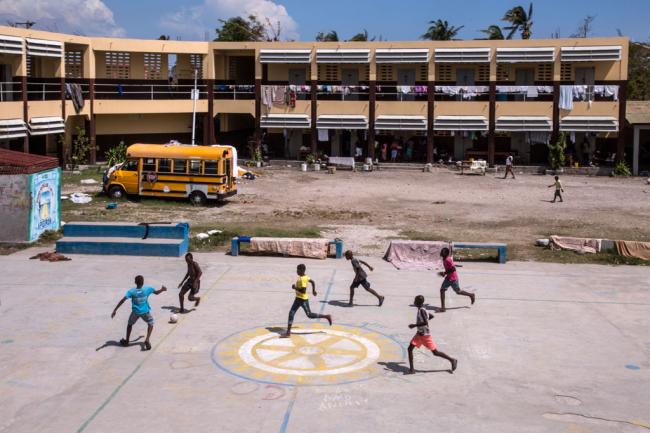
“Schools are not only urgently needed so that children can have some routine restored in their lives and continue learning but the buildings themselves are needed as shelters,” Gomis explained. “Last week we had two full days of rain which meant that people already with no roof over their heads were hit again.”
UNESCO supports the Worldwide Initiative for Safe Schools, which advocates for long-term resilience of the education community – important in a country among the most exposed to disaster risks.
As one of the primary partners of the Ministry of Education, UNESCO Port-au-Prince is focused on providing sustainable assistance while at the same time reducing vulnerability to future disasters.
It has been supporting the education ministry in integrating Disaster Risk Reduction into the formal education system, including standardized instruction tools as well as training school directors and teachers on risks and best practices.
The UN’s education arm is also facilitating in the evaluation of vulnerability of more than 100 schools in the country’s northern departments and implementing public education and awareness activities.
UNESCO hopes to widen its array of longer-term activities to affected territories and adapt its education response to the specific needs of the most vulnerable communities – aiming to reduce disaster risks exposure and ensure prompt catastrophe recovery.
Photo: UNICEF/Roger LeMoyne
Source: www.justearthnews.com
Support Our Journalism
We cannot do without you.. your contribution supports unbiased journalism
IBNS is not driven by any ism- not wokeism, not racism, not skewed secularism, not hyper right-wing or left liberal ideals, nor by any hardline religious beliefs or hyper nationalism. We want to serve you good old objective news, as they are. We do not judge or preach. We let people decide for themselves. We only try to present factual and well-sourced news.
Support objective journalism for a small contribution.


