


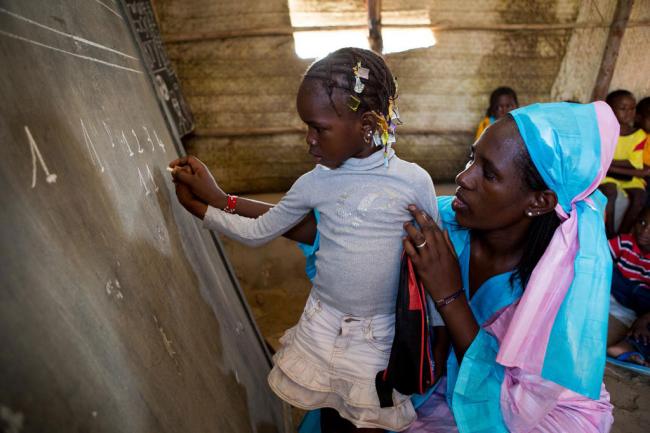
Help 'can't come soon enough' for thousands of children out of school in northern Mali - UNICEF
According to the agency, these children – aged seven to 15 – remain out of school in insecure regions in northern Mali three months into the new school year and almost four years since the security situation worsened in that part of the country.
“Children in northern Mali know too well the impact of conflict, poverty and deprivation,”said Fran Equiza, UNICEF Representative in Mali. “Education is their best hope for the future,” he added.
More than 280 schools, or one in six, in the conflict-affected areas in northern Mali are closed, many of them for the third year in a row, after they were damaged, destroyed, looted or occupied by the warring parties, said UNICEF.
In Kidal, one of the worst hit areas, the agency noted that 79 per cent of schools remain closed. The journey to and from school remains unsafe, and fear of unexploded mines and other remnants of war have forced parents to keep their children away from the classrooms.
Violence has also led to a shortage of teachers, and according to UNICEF, nearly 600 teachers have fled the conflict areas or are no longer reporting to work because of insecurity.
In light of all this, UNICEF is helping to give children back their right to education. Through a two-year campaign called 'Every Child Counts,' the agency provides: training opportunities and learning materials for 2,000 teachers; individual kits for students and school kits to reach 100,000 children; peacebuilding activities for 100,000 children; and 10,000 booklets promoting peace and non-discrimination for students and their communities.
The campaign will also provide alternative and accelerated learning programmes, including lessons via radio, for out-of-school children. Further, schools will be rehabilitated and children will be educated about the danger of unexploded ordnance.
Despite the immense needs, UNICEF’s programmes in the country are hindered by constrained access and limited funding. The UN children’s agency has received less than a third of the $37 million it needs for its education, protection, health, nutrition and water, sanitation and hygiene initiatives.
“The dream of building a better future for Mali’s children depends on action now,” Equiza said, stressing that: “Better humanitarian access and more resources can’t come soon enough for those who have been deprived for so long. Education is their best hope for the future.”
Photo: UNICEF/UNI203065/Dicko
Support Our Journalism
We cannot do without you.. your contribution supports unbiased journalism
IBNS is not driven by any ism- not wokeism, not racism, not skewed secularism, not hyper right-wing or left liberal ideals, nor by any hardline religious beliefs or hyper nationalism. We want to serve you good old objective news, as they are. We do not judge or preach. We let people decide for themselves. We only try to present factual and well-sourced news.
Support objective journalism for a small contribution.


