Haiti: UN official says cholera outbreak needs urgent attention
“When cooperation funds dry up, the response teams on the ground no longer have resources to adequately respond to alerts, treat patients and prevent further deaths,” wrote Pedro Medrano Rojas, the Senior Coordinator for the Cholera Response in Haiti, in an opinion piece published in Wiener Zeitung.
Medrano said the epidemic has caused 9,000 deaths and affected more than 735,000 people since October 2010 when the outbreak began in the aftermath of the earthquake.
“Engraved in our memories are dreadful images of dilapidated buildings and people trying to survive in the midst of the disaster,” he said.
He added, “And we can also remember the outstanding international mobilization, committed both to reconstructing the country and fighting the cholera epidemic that emerged months later.”
He said it was understandable that television cameras were now in Nepal, where an earthquake similar to the one in Haiti had occurred.
“But we cannot forget cholera,” he said.
He added, “The cholera epidemic in Haiti is still a humanitarian emergency that requires urgent attention. How would we react if any other country forecasted 28,000 cases of cholera for 2015?”
That World Health Organization (WHO) forecast could be even worse if efforts were not made to correct the course and Medrano said the latest UN cholera fact sheet revealed that the situation is going through its worst moment in the last three years.
Heavy rains in September 2014 combined with the lack of resources for an appropriate response reversed previous declines, he said, adding that since then Cholera cases “skyrocketed” from approximately a thousand per month to nearly a thousand per week, with 113 people dying between January and March.
“Despite the alarming situation and the worrying estimates for 2015, the cholera epidemic has fallen off the radar of most donors,” Medrano said.
“The lack of resources has already led to the closure of 91 of the 250 treatment centres in the country and has caused the departure of many international partners from the country.”
He said the humanitarian community needed $36 million to secure the response capacity and he stressed that the disease was “easily treatable” through antibiotics and hydration.
“No one should die from cholera in the twenty-first century,” Medrano continued.
He said, “But Haiti is at a disadvantage, as the poorest country in Latin America and one of the poorest in the entire world. Its health system is very limited and its national sanitation system barely covers one in every four people.”
He pointed to the many positive results in Haiti stemming from international cooperation, including a huge drop in the number of displaced persons, an 88 per cent increase in primary school attendance and the reaching of the Millennium Development Goals (MDGs) on underweight children in 2012.
“Cholera in Haiti can be eliminated,” he said.
He added, “We have the strategies, roadmaps and coordination mechanisms with the Government in place to do so. What we need now is a stronger commitment of the international cooperation. Stopping our support now will risk losing everything.”
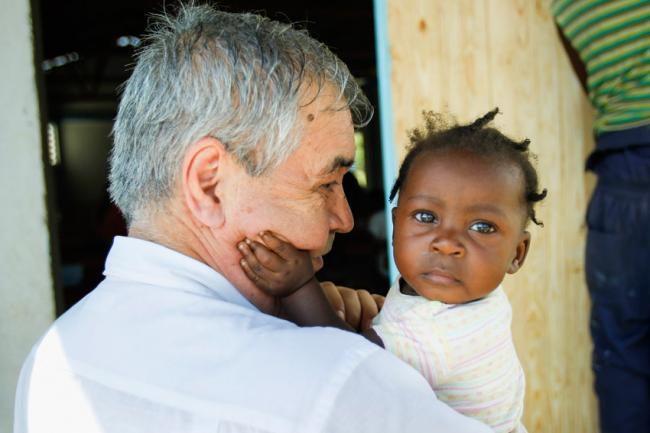
Photo: UN Photo/Paulo Filgueiras
Support Our Journalism
We cannot do without you.. your contribution supports unbiased journalism
IBNS is not driven by any ism- not wokeism, not racism, not skewed secularism, not hyper right-wing or left liberal ideals, nor by any hardline religious beliefs or hyper nationalism. We want to serve you good old objective news, as they are. We do not judge or preach. We let people decide for themselves. We only try to present factual and well-sourced news.
Support objective journalism for a small contribution.